As electric vehicles (EVs), battery energy storage systems (BESS), and power electronics become more advanced, engineers need testing equipment that can reproduce battery behavior accurately without relying on a physical battery pack for every test. A
bidirectional battery simulator provides this capability by electronically emulating the electrical characteristics of a battery while allowing energy to flow in both directions.
Unlike a conventional DC power supply, which primarily delivers energy to a device under test, a bidirectional battery simulator can both source power to a test system and absorb power from it. This makes it particularly useful for testing applications involving charging, discharging, regenerative braking, energy recovery, and rapidly changing power conditions.
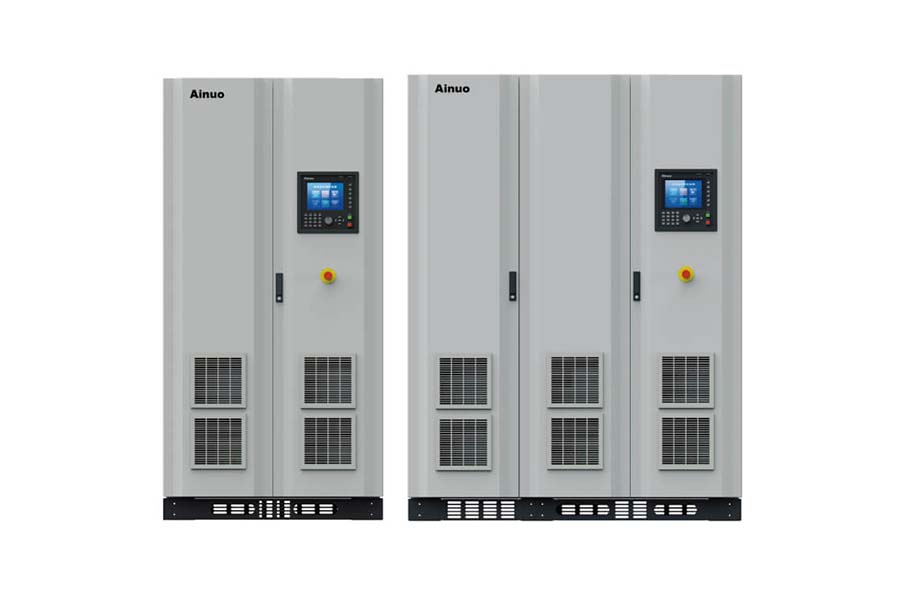
Ainuo's ANEVS(F) battery simulator, for example, combines high-frequency PWM rectification, bidirectional DC conversion, and FPGA-based digital control. Its design supports bidirectional energy flow and rapid switching between forward and reverse energy directions, making it suitable for battery, EV, energy-storage, and photovoltaic-related testing.
What Is a Bidirectional Battery Simulator?
A bidirectional battery simulator is a programmable DC power system designed to reproduce the electrical behavior of a battery without using an actual battery as the primary energy source.
In a typical test setup, the simulator is connected to a device under test such as an EV inverter, motor controller, onboard charger, DC-DC converter, energy-storage converter, or battery-management system. The simulator generates a controlled DC voltage and current that represent the operating characteristics of the target battery.
The key difference is the word bidirectional.
During one operating condition, the simulator acts as a power source. It delivers energy to the device under test, similar to a battery discharging into an EV powertrain.
Under another condition, the direction of power flow reverses. The simulator absorbs electrical energy from the device under test, representing a battery being charged or receiving regenerative energy.
This two-way operation allows engineers to reproduce much more realistic battery operating scenarios than a conventional unidirectional power supply.
The Basic Working Principle
A bidirectional battery simulator generally consists of several functional stages:
- AC input and power conversion
- DC conversion stage
- Digital control system
- Battery model and simulation software
- Measurement and protection system
- Bidirectional energy-flow control
The AC input is converted into a controlled DC output through a power-conversion architecture. In Ainuo’s ANEVS(F), high-frequency PWM rectification is combined with bidirectional DC conversion and FPGA digital control.
The digital controller continuously monitors voltage, current, power, and programmed battery-model parameters. Based on these inputs, it adjusts the power converter so that the output behaves according to the selected battery model or test profile.
The result is an electronically controlled battery equivalent whose voltage and current characteristics can be changed through software rather than by physically replacing a battery pack.
How Does Energy Flow in Both Directions?
The central feature of a bidirectional battery simulator is its ability to control power in both directions.
Consider an EV powertrain test.
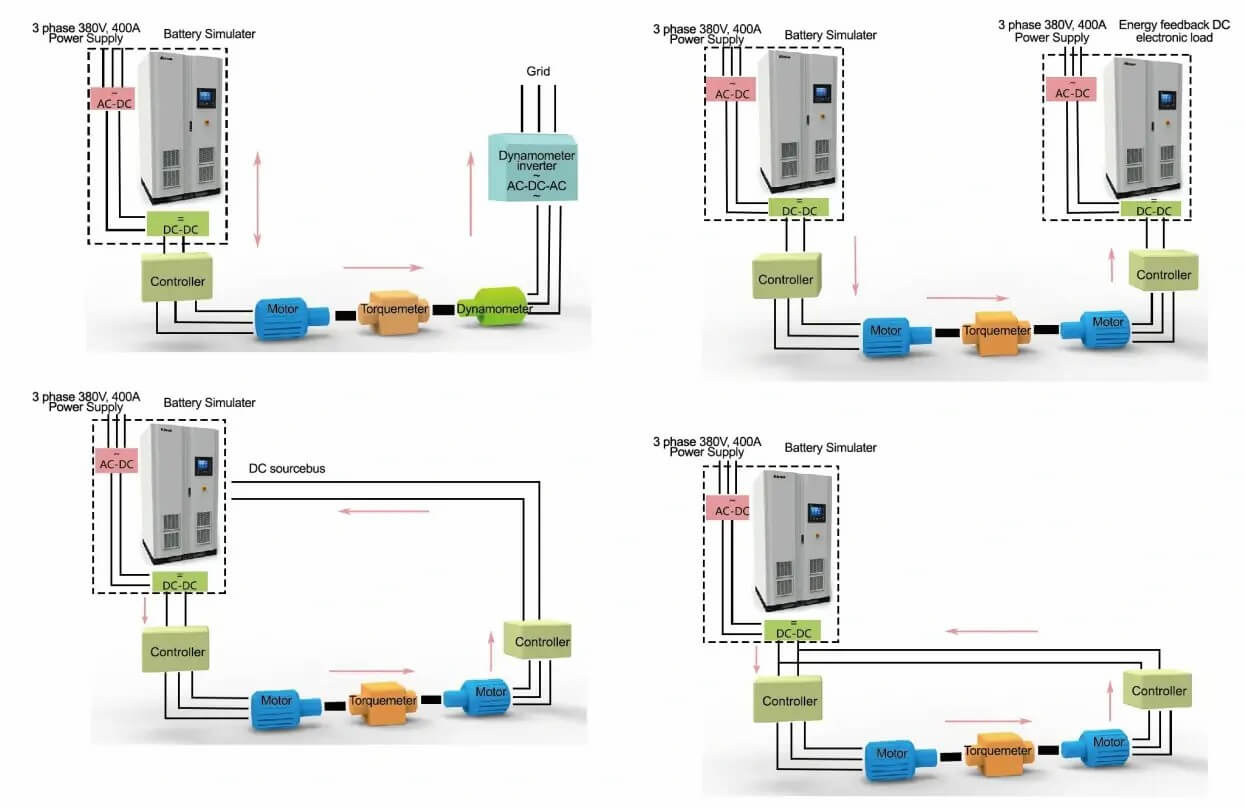
When the electric motor consumes energy, the simulator supplies DC power to the inverter. The inverter converts the DC energy into the appropriate electrical waveform for the motor. From the perspective of the test system, the simulator behaves like a traction battery delivering energy.
Now consider regenerative braking. The motor can operate as a generator and send electrical energy back through the inverter toward the DC bus. Instead of allowing that energy to accumulate or dissipating it through a conventional load, a bidirectional simulator can absorb the returned energy.
This is especially valuable for testing systems that repeatedly transition between motoring and regeneration.
The energy-flow sequence can therefore be summarized as:
Simulator → DC bus → inverter/motor system
during battery discharge, and:
Inverter/motor system → DC bus → simulator
during battery charging or regenerative operation.
Fast control of these transitions is important because real EV systems can experience rapid changes in current and power.
The Role of Battery Modeling
Simply generating a fixed DC voltage does not make a power supply a battery simulator.
A real battery has dynamic electrical behavior. Its terminal voltage can depend on state of charge (SOC), current, temperature, internal resistance, battery chemistry, and other operating conditions.
A sophisticated battery simulator therefore uses mathematical models to reproduce these characteristics.
Depending on the application, a model may represent:
- Open-circuit voltage
- Internal resistance
- State of charge
- Charge and discharge behavior
- Voltage response to current changes
- Battery chemistry characteristics
- Dynamic transient behavior
The ANEVS(F), for example, supports several battery types, including ternary lithium, lithium iron phosphate (LFP), lithium titanate (LTO), lithium cobalt oxide (LCO), lithium manganese oxide (LMO), nickel-metal hydride (NiMH), and lead-acid. It also supports custom battery modes using first-, second-, and third-order battery models and internal-resistance models.
This flexibility allows engineers to test equipment against different battery characteristics without maintaining a large collection of physical battery packs.
Why CV, CC, CP, and CR Modes Matter
Battery-related test systems often need more than a simple constant-voltage output.
A programmable battery simulator may provide several operating modes, including:
- CV — Constant Voltage: maintains a specified voltage.
- CC — Constant Current: maintains a specified current.
- CP — Constant Power: maintains a specified power level.
- CR — Constant Resistance: emulates a specified resistive behavior.
Ainuo's ANEVS(F) supports CV, CC, CP, and CR working modes.
These operating modes allow engineers to reproduce different electrical conditions and evaluate how a device under test responds to changing power requirements.
For example, a DC-DC converter may need to operate correctly across a wide range of input conditions. A battery simulator can reproduce those conditions in a controlled and repeatable laboratory environment.
Why Fast Dynamic Response Is Important
Real battery systems rarely operate at one perfectly stable operating point.
An EV can transition from acceleration to cruising, from cruising to regenerative braking, or from low power to high power within a short period. Similarly, an energy-storage converter can experience rapid changes in commanded power.
If a battery simulator responds too slowly, the test system may not experience the intended electrical conditions.
Fast dynamic response allows the simulator to follow programmed voltage and current changes accurately. The ANEVS(F) specifies a response time of up to 3 ms and switching time of up to 4 ms, according to Ainuo’s published product information.
The simulator also supports programming of up to 900 steps, with a minimum programming time of 1 ms. This enables engineers to construct complex, repeatable test sequences rather than manually changing operating points.
How a Battery Simulator Is Used in EV Testing
One of the most important applications is electric-vehicle powertrain testing.
A simplified test architecture may include:
Bidirectional battery simulator → inverter → electric motor
The simulator represents the vehicle’s battery pack. The inverter and motor then operate under controlled battery-side conditions.
Engineers can use this configuration to evaluate:
- Motor controllers
- Inverters
- Electric drive systems
- DC-DC converters
- Onboard chargers
- EV powertrain components
- Charging systems
- Battery-management-related functions
Ainuo identifies new-energy vehicle motors, electric-drive systems, vehicle systems, and related testing applications among the intended applications of its battery simulator platform. Its broader solution portfolio also includes drive motor/electronic-control, OBC and DC-DC, power-battery, EV-part, and charging-pile test solutions.
The Advantages Over Testing Only With a Real Battery
Physical batteries remain essential for many validation activities, but they also introduce practical challenges.
Battery packs can be expensive, heavy, difficult to transport, and potentially hazardous. Their characteristics can also change with temperature, aging, SOC, and previous operating history.
A programmable battery simulator provides a controlled alternative during development and laboratory testing.
Key advantages include:
Repeatability
The same programmed battery profile can be reproduced repeatedly. This makes it easier to compare different hardware or software revisions.
Programmability
Engineers can change voltage, current, power, and battery-model parameters without physically modifying the battery system.
Safety and controllability
The test environment can incorporate programmable output limits and protection parameters. Ainuo states that the ANEVS(F) supports programmable protection and output-parameter limits.
Faster development
Engineers can reproduce abnormal or demanding operating conditions directly through programmed test sequences rather than waiting for a physical battery to reach a particular state.
Reduced dependence on physical batteries
A simulator can handle many development and characterization tests before engineers move to final validation with an actual battery pack.
Bidirectional Operation and Regenerative Energy
Another important benefit is energy recovery.
When a test system sends electrical energy back toward the battery side, a conventional power supply cannot necessarily absorb that energy. A separate electronic load may be required, and the returned energy may ultimately be converted into heat.
A bidirectional architecture can instead accept the energy through its reverse power path.
This is particularly useful when testing regenerative braking or repeated charge-discharge cycles.
For high-power laboratories, this approach can help improve overall test-system efficiency because energy does not necessarily have to be dissipated as heat during every reverse-power event.
Beyond Battery Simulation
An interesting characteristic of the ANEVS(F) platform is that it combines battery simulation with photovoltaic simulation.
The system can simulate PV I-V curves and support different photovoltaic operating conditions, while also providing battery simulation capabilities. Ainuo states that the platform supports standard curves such as Sandia and EN50530 and can perform both static and dynamic PV simulation.
This makes the concept broader than a battery-only test source.
The same class of programmable power-conversion platform can therefore be applied to testing involving batteries, PV inverters, energy-storage converters, and other new-energy equipment.
Communication and Automated Testing
Modern battery testing rarely operates as a completely manual process.
Automated test systems need communication interfaces through which a host computer, test controller, or laboratory automation platform can configure operating parameters and collect measurements.
The ANEVS(F) supports interfaces including CAN, RS232/RS485, and LAN.
These interfaces can support automated test sequences, data acquisition, remote configuration, and integration with broader test benches.
For R&D laboratories and production test environments, this is important because automation improves repeatability and reduces the amount of manual intervention required during long-duration test sequences.
What Should Engineers Look for in a Bidirectional Battery Simulator?
When selecting a battery simulator, engineers should evaluate more than its maximum power rating.
Important specifications and capabilities include:
Voltage and current range: The simulator must cover the complete operating envelope of the device under test.
Bidirectional power capability: Check whether the equipment can both source and sink the required power.
Dynamic response: A faster response is important for transient and regenerative testing.
Battery models: Verify whether the simulator supports the battery chemistries and mathematical models required by the project.
Programming capability: Look at the number of programmable steps, minimum step duration, and profile-management functions.
Accuracy: Voltage and current accuracy directly affect the quality of test results.
Protection functions: Programmable voltage, current, power, and other limits can help protect expensive equipment under test.
Communication interfaces: CAN, LAN, RS-232, RS-485, and other interfaces can determine how easily the simulator integrates into an automated test system.
Thermal performance: High-power testing can generate substantial heat, making the cooling architecture an important consideration.
Ainuo's published ANEVS(F) specifications include 0.05% F.S. voltage accuracy, 0.1% F.S. current accuracy, power factor above 0.99, current harmonic distortion of no more than 3%, and an independent airflow-channel cooling design intended to avoid derating within 40°C.
Conclusion
A bidirectional battery simulator combines programmable power conversion, battery modeling, digital control, measurement, and two-way energy management into a single test platform.
Instead of simply producing a fixed DC voltage, it electronically reproduces the behavior of a battery and dynamically adjusts its electrical output according to a programmed model or test profile. When the device under test consumes power, the simulator operates as a source. When the test system returns energy, the simulator can operate in reverse and absorb it.
This capability makes bidirectional battery simulators particularly valuable for EV powertrain testing, battery-pack testing, onboard chargers, DC-DC converters, energy-storage converters, charging equipment, and other new-energy applications.
As electrification continues to increase the complexity of power systems, programmable and bidirectional test equipment provides engineers with a safer, more repeatable, and more flexible way to reproduce real-world operating conditions in the laboratory. The ANEVS(F) illustrates this approach by combining battery and PV simulation, multiple battery models, fast dynamic response, programmable operating profiles, bidirectional energy flow, and multiple communication interfaces in a single test platform.
For engineers developing or validating EV and energy-storage technologies, understanding how a bidirectional battery simulator works is therefore more than a matter of power-supply technology—it is an important part of designing a reliable, repeatable, and efficient test strategy.



 TEL:+86 532 83995188
 PHONE:+86 177 5322 5039
 E-MAIL:ainuo@ainuo.com
 ADDRESS:No. 134 Zhuzhou Rd, Laoshan District, Qingdao, China