As the global automotive industry shifts toward electrification, new energy vehicles (NEVs) are placing increasingly demanding requirements on electric drive motors. Higher operating voltages, faster switching frequencies, compact motor designs, and higher power densities all contribute to greater stress on motor insulation systems.
For manufacturers, ensuring the reliability of the motor’s insulation is therefore essential. A small insulation defect that may initially appear harmless can develop into a serious failure under continuous electrical, thermal, and mechanical stress.
This is where partial discharge (PD) testing becomes an important quality-control and insulation-diagnostic method.
What Is Partial Discharge?
Partial discharge is a localized electrical discharge that occurs within an insulation system when the electric field exceeds the withstand capability of a small area of the insulation. Unlike a complete breakdown, partial discharge does not immediately bridge the entire insulation path.
PD can occur because of:
- Voids or air pockets inside insulation
- Cracks and delamination
- Contamination
- Sharp edges or local electric-field concentrations
- Poor winding insulation
- Manufacturing defects
- Aging or thermal damage
Although an individual discharge may be extremely small, repeated PD activity can gradually deteriorate insulation. Over time, this can lead to carbonization, erosion, electrical treeing, and eventually insulation breakdown.
For an NEV drive motor operating under demanding conditions, detecting these defects before they develop into a failure is critical.
Why NEV Drive Motors Face Greater Insulation Challenges
Electric vehicle drive motors differ significantly from many traditional industrial motors.
Modern NEV powertrains increasingly use high-voltage systems and sophisticated power electronics. Inverter-driven motors can experience rapid voltage changes and high-frequency voltage components generated by switching devices.
These conditions can increase electrical stress on the motor winding insulation.
At the same time, manufacturers are pursuing higher power density. Motors need to deliver more power while remaining compact and lightweight. This places additional demands on the insulation system and manufacturing process.
The result is a challenging combination of:
Higher voltage + faster switching + greater power density + demanding thermal conditions = increased insulation stress.
Consequently, conventional electrical tests alone may not provide sufficient information about the condition of the insulation system.
How Partial Discharge Testing Helps
Partial discharge testing provides manufacturers with a way to detect localized insulation defects that could otherwise remain hidden during routine production testing.
A PD test can help determine whether a motor begins to experience discharge activity at a particular voltage level. Important parameters include partial discharge inception voltage (PDIV) and repetitive partial discharge inception voltage (RPDIV).
The basic principle is straightforward:
- Apply a controlled voltage to the motor or winding.
- Increase the voltage according to the test procedure.
- Monitor the insulation for discharge activity.
- Identify the voltage at which PD begins.
- Analyze the measured discharge signal.
- Compare the result with the applicable quality criteria.
A lower-than-expected PD inception voltage can indicate a potential insulation weakness that requires further investigation.
PDIV and RPDIV: Important Indicators of Insulation Quality
Two commonly discussed parameters in motor insulation testing are PDIV and RPDIV.
Partial Discharge Inception Voltage (PDIV)
PDIV is the voltage at which partial discharge begins to occur under specified test conditions.
It provides information about the voltage level at which localized insulation defects begin to exhibit discharge activity.
Repetitive Partial Discharge Inception Voltage (RPDIV)
RPDIV focuses on the voltage level associated with repetitive discharge activity. It can be particularly relevant when evaluating insulation systems subjected to repetitive electrical stress.
Together, these measurements can provide valuable insight into the robustness of a motor’s insulation system.
Depending on the test standard and application, other parameters such as partial discharge extinction voltage (PDEV) and repetitive partial discharge extinction voltage (RPDEV) may also be evaluated.
Why UHF Detection Matters
One of the challenges of PD testing is that discharge signals can be extremely weak. In a manufacturing environment, electrical equipment, switching devices, motors, and other sources can generate background interference.
If the PD signal is buried in noise, accurately identifying a small insulation defect becomes more difficult.
High-frequency and ultra-high-frequency (UHF) detection technologies can help improve the ability to capture and process these fast electrical discharge signals.
For NEV motor testing, advanced signal-processing and noise-suppression technologies are especially valuable because production environments are rarely electrically quiet.
A capable PD tester should therefore do more than simply measure a signal. It should also provide effective methods for distinguishing genuine discharge activity from background interference.
AC-PD and DC-PD Testing
Different motor insulation defects may require different testing approaches.
An advanced partial discharge tester can support multiple test modes to address different insulation characteristics.
AC-PD testing can be used to evaluate discharge behavior under alternating-voltage conditions and withstand-voltage-related insulation assessment.
DC-PD testing can be useful for evaluating insulation associated with interturn or other specific motor winding conditions.
Supporting multiple test methods in a single testing platform can simplify the manufacturing test process and allow engineers to develop a more comprehensive insulation evaluation strategy.
The Importance of Multi-Channel Testing
NEV drive motors can contain multiple windings and complex electrical configurations. Testing each relevant winding individually can increase test time and introduce opportunities for operator error.
Multi-channel PD testing can help address this challenge.
With channel switching and automated measurement, manufacturers can test multiple winding connections using a more standardized procedure. This can improve:
- Test consistency
- Production throughput
- Measurement repeatability
- Operator efficiency
- Test-data traceability
For high-volume motor manufacturing, automation is particularly important because insulation testing needs to be both technically reliable and production-friendly.
Partial Discharge Testing and Production Quality Control
PD testing should not be viewed only as a laboratory diagnostic technique.
When properly integrated into a production line, it can become an important part of the motor quality-control process.
A production testing system can automatically apply the required voltage, monitor PD activity, determine test results, and record measurement data. Communication interfaces such as LAN, RS232, USB, and PLC connections can also facilitate integration with automated manufacturing systems.
Integration with MES (Manufacturing Execution System) platforms can further improve traceability.
Manufacturers can potentially associate test results with individual motors, production batches, operators, or manufacturing processes. This makes it easier to identify abnormal trends and investigate quality problems.
Detecting Problems Before Motor Failure
The greatest value of PD testing is not simply obtaining a pass/fail result. It is gaining visibility into insulation quality before a serious failure occurs.
Consider a motor winding containing a small manufacturing defect.
Initially, the motor may pass several conventional electrical tests. However, under sufficiently high electrical stress, localized discharge may begin around the defect.
Repeated discharge gradually damages the surrounding insulation. If the defect continues to develop, it can eventually result in a short circuit or complete insulation breakdown.
PD testing provides an opportunity to identify this type of weakness earlier in the manufacturing and quality-assurance process.
How to Choose a PD Tester for NEV Motors
When selecting partial discharge test equipment for new energy vehicle drive motors, manufacturers should consider more than the nominal voltage range.
Important factors include:
1. PD Detection Sensitivity
The tester should be capable of detecting weak discharge signals reliably under realistic production conditions.
2. Noise Suppression
Effective background-noise rejection is essential, particularly in automated factories containing numerous electrical and switching devices.
3. PD Measurement Parameters
The equipment should support the parameters required by the applicable test procedure, such as PDIV, RPDIV, PDEV, and RPDEV where appropriate.
4. Test Voltage and Resolution
The available voltage range and voltage-step resolution should match the requirements of the motor and the relevant testing standards.
5. Multi-Channel Capability
For motors with multiple winding connections, multi-channel testing can significantly improve testing efficiency.
6. Automation and Communication
PLC, LAN, RS232, USB, and other communication options can make it easier to integrate the tester into automated production and data-management systems.
7. Data Traceability
The ability to record and export test results is increasingly important for modern automotive manufacturing, where quality data must often be linked to individual components and production processes.
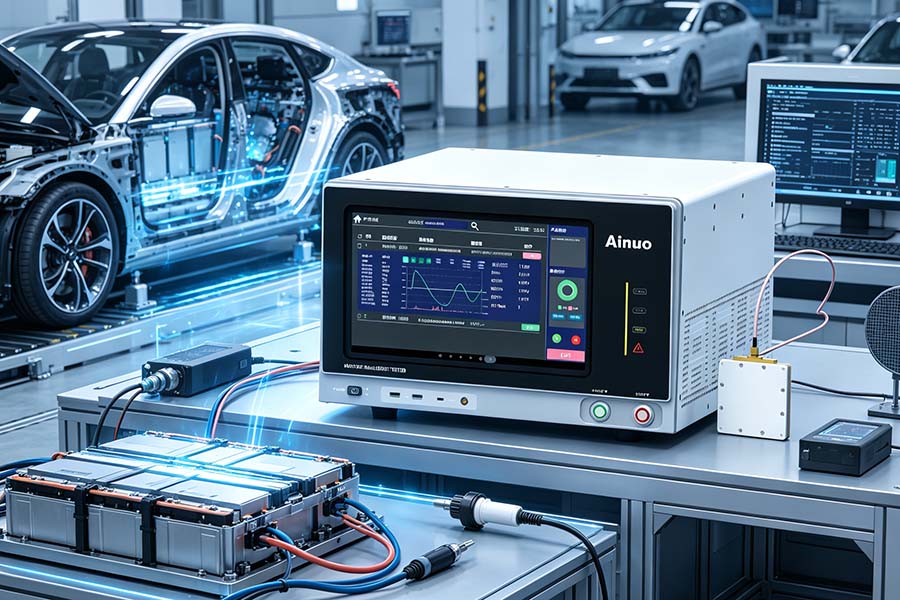
The Role of the AN8A10PD(F) Partial Discharge Tester
Its capabilities include PD-related measurements such as PDIV, RPDIV, PDEV, and RPDEV, as well as AC-PD and DC-PD testing modes. The system also incorporates high-frequency signal detection and signal-processing functions designed to help identify weak PD signals in the presence of background noise.
For production applications, its multi-channel testing capability and communication interfaces can support automated motor testing and integration with manufacturing systems.
These features make this type of equipment particularly relevant to manufacturers developing quality-control processes for NEV drive motors.
Conclusion
As new energy vehicle drive motors become more powerful, compact, and electrically sophisticated, insulation reliability becomes increasingly important.
Partial discharge testing provides manufacturers with a valuable method for identifying localized insulation weaknesses before they develop into serious failures. By evaluating PD behavior and parameters such as PDIV and RPDIV, manufacturers can gain additional insight into the quality and robustness of their motor insulation systems.
For high-volume NEV motor production, the ideal solution is not simply a sensitive PD detector. Manufacturers need a testing platform that combines accurate measurement, noise suppression, multiple test modes, multi-channel capability, automation, and data traceability.
By incorporating partial discharge testing into the motor manufacturing and quality-control process, manufacturers can improve insulation reliability, detect potential defects earlier, and build greater confidence in the long-term performance of new energy vehicle drive motors.



 TEL:+86 532 83995188
 PHONE:+86 177 5322 5039
 E-MAIL:ainuo@ainuo.com
 ADDRESS:No. 134 Zhuzhou Rd, Laoshan District, Qingdao, China