The rapid growth of the electric vehicle (EV) industry has placed battery technology at the center of vehicle performance, safety, and reliability. As automakers and battery manufacturers strive to improve energy density, charging speed, and battery lifespan, comprehensive testing has become a critical part of research, development, validation, and production processes.
To accurately simulate real-world battery behavior, testing systems must support both charging and discharging operations with high precision and efficiency. Bidirectional programmable DC power supplies have emerged as a key enabling technology, offering the ability to source and sink power within a single platform. Their flexibility, regenerative capabilities, and advanced control functions make them an essential solution for modern EV battery testing applications.
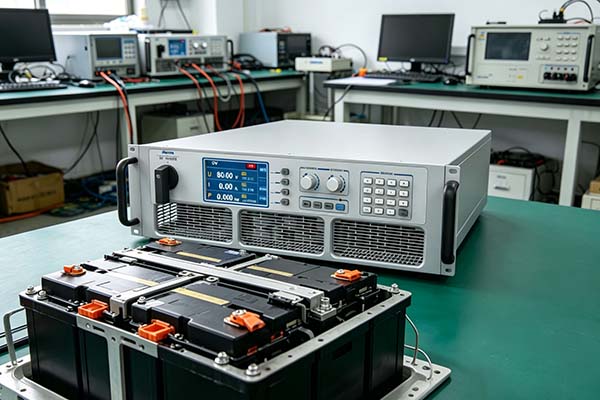
An EV battery pack is far more than a collection of battery cells. It is a highly integrated energy storage system consisting of:
Before deployment in a vehicle, batteries must undergo extensive validation testing, including:
These tests often involve repeated transitions between charging and discharging states while handling significant power levels ranging from a few kilowatts to several hundred kilowatts.
Traditional testing architectures frequently rely on separate power supplies and electronic loads. While functional, this approach introduces inefficiencies, complexity, and higher operating costs. The Bidirectional programmable DC power supply addresses these limitations by integrating both functions into a single platform.
A bidirectional programmable DC power supply is an advanced power conversion system capable of operating in two modes:
In source mode, the unit supplies DC power to charge the battery under test.
Applications include:
In sink mode, the unit absorbs energy from the battery during discharge.
Applications include:
Unlike traditional electronic loads that dissipate energy as heat, modern bidirectional power supplies often regenerate absorbed energy back to the AC grid, dramatically reducing energy consumption.
One of the most important requirements in EV battery testing is the ability to replicate actual vehicle operating scenarios.
During vehicle operation, batteries continuously alternate between:
A bidirectional programmable DC power supply can seamlessly transition between sourcing and sinking power, accurately reproducing these conditions.
For example, when testing regenerative braking behavior, engineers can simulate energy flowing back into the battery while validating:
This capability allows manufacturers to identify issues before vehicles enter production and ensures compliance with automotive standards.
Battery cycling is among the most common tests performed in EV development.
A typical cycling procedure may involve:
Such tests help determine:
Bidirectional programmable power supplies simplify this process by handling both charge and discharge functions within a single system.
Benefits include:
For large battery packs operating at hundreds of volts and hundreds of amperes, these advantages become even more significant.
Energy consumption is a major concern in battery testing facilities.
Consider a laboratory conducting continuous battery cycling on a 150 kWh battery pack. During discharge testing, substantial amounts of energy must be absorbed.
Traditional electronic loads convert this energy into heat, creating two significant challenges:
Every kilowatt-hour discharged from the battery is effectively lost.
Large amounts of heat require extensive HVAC systems, increasing operational costs.
Bidirectional regenerative DC power supplies solve both problems.
Instead of dissipating energy, they return recovered power to the facility’s electrical grid.
Industrial users commonly achieve:
For battery testing facilities operating around the clock, regenerative technology can yield substantial cost savings over the equipment's lifetime.
The Battery Management System serves as the intelligence center of an EV battery pack.
Its responsibilities include:
Validating BMS functionality requires precise control of voltage and current under varying operating conditions.
Bidirectional programmable DC power supplies offer:
Engineers can simulate:
These capabilities help verify that the BMS performs correctly under both normal and abnormal operating conditions.
Battery testing often extends beyond the battery itself.
Automotive manufacturers also test:
Bidirectional DC power supplies can emulate battery behavior while interacting with these components.
For example, during charger validation, the power supply can act as a battery pack and dynamically adjust its voltage according to charging conditions.
This approach provides:
As a result, manufacturers can accelerate product launches while maintaining rigorous validation standards.
Modern EV battery systems often operate between 400 V and 1000 V.
Testing at these voltage levels introduces substantial safety concerns.
Industrial-grade bidirectional programmable DC power supplies incorporate advanced protection mechanisms such as:
These built-in safety features reduce risk for personnel and equipment while supporting compliance with automotive testing standards.
Additionally, programmable operating limits help prevent accidental battery damage during testing.
Battery testing is not limited to research laboratories.
Production facilities increasingly perform automated testing during manufacturing processes.
Common applications include:
Bidirectional programmable DC power supplies integrate easily with:
Through programmable interfaces such as:
Manufacturers can build highly automated test stations capable of supporting high-volume production environments.
Battery technology continues to evolve rapidly.
Emerging technologies include:
Testing requirements will become increasingly demanding as battery capacities and voltage levels rise.
Modern bidirectional programmable DC power supplies are designed with scalability in mind, offering:
These features allow testing facilities to adapt to future technologies without complete infrastructure replacement.
While bidirectional programmable DC power supplies may require a higher initial investment compared to conventional testing equipment, the long-term financial benefits are compelling.
Cost savings arise from:
Additionally, integrating sourcing and sinking functions into a single platform reduces the need for separate power supplies and electronic loads.
For large-scale battery testing operations, these advantages can significantly reduce the total cost of ownership over the system lifecycle.
As EV batteries become more powerful and sophisticated, testing requirements continue to increase in complexity. Traditional test setups that rely on separate power supplies and electronic loads often struggle to deliver the efficiency, flexibility, and scalability required in today's battery development and manufacturing environments.
Bidirectional programmable DC power supplies address these challenges by combining charging and discharging functions, enabling energy regeneration, supporting advanced battery simulations, and simplifying automated test systems. From R&D laboratories to large-scale production facilities, they have become a fundamental technology for improving testing efficiency, reducing operating costs, and ensuring the reliability and safety of next-generation EV batteries.
*Please fill in the required information carefully, and we will contact you within 4-8 hours.

 TEL:+86 532 83995188
 PHONE:+86 177 5322 5039
 E-MAIL:ainuo@ainuo.com
 ADDRESS:No. 134 Zhuzhou Rd, Laoshan District, Qingdao, China


Copyright©2025. Aino Instrument Co., Ltd All Rights Reserved.
Powered by:WDL