The global demand for advanced battery technologies has never been greater. From electric vehicles (EVs) and renewable energy storage systems to consumer electronics and industrial equipment, batteries are becoming the foundation of modern electrification. As governments and industries pursue carbon neutrality goals and energy transition initiatives, battery manufacturers are under increasing pressure to develop safer, more efficient, and longer-lasting energy storage solutions.
However, battery innovation is not simply about discovering new materials or chemistries. Bringing a battery from concept to commercialization requires extensive research, testing, validation, and optimization. Engineers must evaluate performance, safety, reliability, and lifecycle characteristics under countless operating conditions. This process often consumes significant time, energy, and resources.
Traditional testing infrastructures are increasingly struggling to meet the demands of modern battery development. Long testing cycles, high operational costs, massive data generation, and evolving performance requirements present significant obstacles to accelerating research and development (R&D).
To overcome these challenges, many leading battery developers are adopting a combination of bidirectional power supplies and automated test systems. Together, these technologies enable faster testing, greater energy efficiency, improved data quality, and higher laboratory productivity. More importantly, they help organizations shorten development cycles and bring innovative battery technologies to market more quickly.
This article explores the key industrial challenges facing battery R&D and examines how a bidirectional power supply integrated with automated test systems provides effective solutions.
Battery technology is evolving at an unprecedented pace. Researchers are simultaneously working on multiple battery chemistries and architectures, including:
Each technology exhibits unique electrical and thermal characteristics. Charging profiles, voltage ranges, degradation mechanisms, and safety considerations can vary significantly between battery types.
As a result, R&D laboratories require highly flexible testing platforms capable of adapting to diverse testing requirements. Traditional power supplies and standalone electronic loads often lack the versatility necessary to support rapidly changing research objectives.
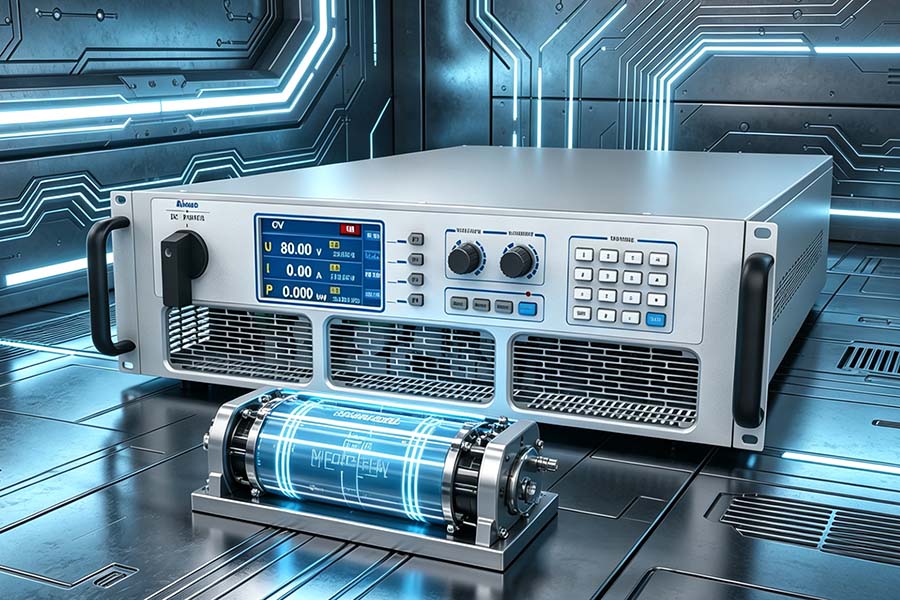
A bidirectional power supply combines the functions of a programmable DC power source and an electronic load within a single system.
This flexibility enables engineers to:
Researchers can therefore evaluate multiple battery technologies using a unified testing platform, significantly improving laboratory efficiency and reducing setup time.
Battery development is inherently time-consuming. Before a battery can be commercialized, engineers must conduct extensive testing, including:
Some tests require hundreds or even thousands of cycles to accurately assess long-term performance and degradation behavior.
When testing procedures are manually configured and monitored, development timelines can quickly extend from months to years.
Automated test systems eliminate many of the inefficiencies associated with manual testing.
Modern test automation software enables engineers to:
By reducing human intervention, automated systems significantly increase laboratory utilization and throughput.
For example, a battery cycling test that previously required daily operator supervision can now run continuously with automated monitoring and control. Researchers can focus on analyzing results and improving designs rather than managing equipment.
The result is faster validation and shorter development cycles.
Battery testing can consume enormous amounts of electrical energy, particularly when evaluating high-capacity EV battery packs or grid-scale energy storage systems.
In conventional test setups, batteries discharge into electronic loads that convert valuable electrical energy into heat. This wasted energy creates several challenges:
As testing volumes grow, energy waste becomes a major financial and environmental concern.
One of the most valuable advantages of a bidirectional power supply is regenerative operation.
Instead of dissipating discharge energy as heat, the system recovers the energy and feeds it back into the facility’s AC grid.
This capability delivers several benefits:
Reduced Operating Costs
Energy recovery significantly lowers electricity consumption, reducing utility expenses for battery laboratories.
Lower Cooling Requirements
Because less energy is converted into heat, HVAC systems operate more efficiently and cooling infrastructure requirements are reduced.
Improved Sustainability
Regenerative testing aligns with corporate sustainability goals by minimizing energy waste and reducing carbon emissions.
Higher Laboratory Efficiency
Facilities can conduct more tests without a proportional increase in energy costs.
For large-scale battery testing operations, regenerative bidirectional power supplies can generate substantial cost savings over the lifetime of the equipment.
Modern batteries operate in highly dynamic environments.
An EV battery experiences rapid acceleration, regenerative braking, varying temperatures, and fluctuating load demands. Similarly, batteries used in renewable energy systems must respond to intermittent solar and wind generation.
Traditional test equipment often struggles to replicate these complex operating conditions accurately.
As a result, laboratory data may not fully reflect real-world performance.
Advanced bidirectional power supplies provide high-speed response and programmable operating modes that enable realistic simulation scenarios.
Engineers can emulate:
By reproducing actual operating conditions, researchers gain deeper insights into battery behavior before deployment.
This leads to:
Modern battery testing generates enormous quantities of data.
During a single cycling experiment, engineers may monitor:
As testing scales across multiple channels and projects, data management becomes increasingly complex.
Common issues include:
Without effective data management, valuable insights can be lost.
Automated test systems provide centralized data collection and management capabilities.
These systems automatically:
Researchers can quickly identify trends, compare experiments, and make data-driven decisions.
Furthermore, automated systems enable integration with advanced analytics tools, machine learning algorithms, and predictive modeling platforms.
This transforms raw test data into actionable intelligence.
Battery testing involves significant safety risks, particularly when working with:
Manual operation increases the likelihood of human error and delayed response to abnormal events.
Safety incidents can damage equipment, delay projects, and endanger personnel.
Modern automated test systems continuously monitor critical operating parameters.
Protective features may include:
When integrated with a bidirectional power supply, these systems can react instantly to unsafe conditions.
This proactive approach significantly improves laboratory safety and reduces operational risks.
Battery development typically progresses through several stages:
Many organizations use different equipment at each stage, resulting in inconsistent methodologies and fragmented datasets.
Scaling research from small cells to large battery packs can therefore become a major bottleneck.
A modern bidirectional power supply architecture supports a broad range of power levels and testing requirements.
Combined with modular automated test systems, laboratories can establish a unified testing framework that supports:
This consistency improves data comparability and simplifies the transition between development stages.
Researchers can maintain standardized procedures throughout the entire battery lifecycle.
While each technology delivers substantial benefits individually, their true value emerges when deployed together.
A bidirectional power supply provides the electrical performance, flexibility, and energy efficiency required for modern battery testing. Automated test systems provide the intelligence, control, and data management necessary to maximize productivity.
Together, they enable:
This integrated approach transforms battery laboratories into highly efficient R&D environments that support next-generation energy storage innovation.
The battery industry is facing unprecedented pressure to develop higher-performance energy storage solutions while reducing development timelines and controlling costs. However, increasing battery complexity, lengthy testing cycles, rising energy consumption, data management challenges, and safety requirements continue to hinder R&D productivity.
A bidirectional power supply and automated test systems provide a powerful solution to these challenges. Bidirectional technology enables efficient charging and regenerative discharging, reducing energy waste and operational expenses. Automated testing platforms streamline workflows, improve data accuracy, enhance safety, and maximize laboratory utilization.
As battery technologies continue to evolve toward higher power densities, faster charging capabilities, and greater integration with renewable energy systems, the need for intelligent and efficient testing infrastructure will only increase. Organizations that invest in advanced bidirectional power supplies and automated test systems today will be better positioned to accelerate innovation, reduce time-to-market, and gain a competitive advantage in the rapidly expanding energy storage industry.
In the race to develop the batteries that will power the future, smarter testing is becoming just as important as smarter chemistry.
*Please fill in the required information carefully, and we will contact you within 4-8 hours.

 TEL:+86 532 83995188
 PHONE:+86 177 5322 5039
 E-MAIL:ainuo@ainuo.com
 ADDRESS:No. 134 Zhuzhou Rd, Laoshan District, Qingdao, China


Copyright©2025. Aino Instrument Co., Ltd All Rights Reserved.
Powered by:WDL