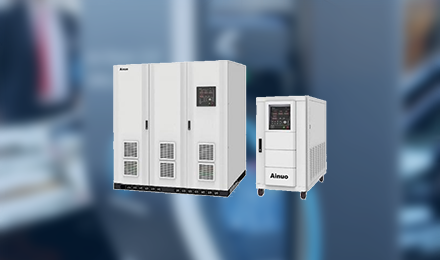
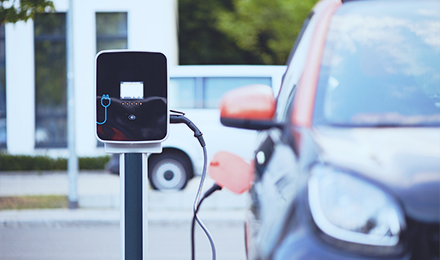
In the rapidly evolving electric vehicle (EV) industry, validating the performance and safety of electric power systems is non-negotiable. At the heart of every EV's charging architecture is the On-Board Charger (OBC) — the power electronics module that converts grid AC power into DC power to charge the battery. Testing these OBCs thoroughly before production launch or certification is a complex engineering challenge. Enter regenerative AC sources and loads, a powerful class of electrical test equipment tailored to meet today's EV testing demands.
In this blog, we'll decode what regenerative AC source-load systems are, why they are essential for OBC testing, explore real test challenges encountered today, and highlight how solutions like the Ainuo ANRGL(F) Regenerative AC Source and Load fit into the landscape.
What Is a Regenerative AC Source and Load?
A regenerative AC source and load is an advanced power test equipment capable of both supplying power to and absorbing power from a device under test (DUT). Its defining feature is energy regeneration — the ability to return absorbed power back to the electrical grid rather than wasting it as heat, which drives efficiency and reduces operational cost.
From a functional standpoint, the regenerative unit operates in four quadrants — sourcing and sinking power in both AC and DC modes. This capability enables it to simulate real-world electrical environments with high fidelity, including variable voltage, frequency disturbances, non-linear loads, and fault conditions.
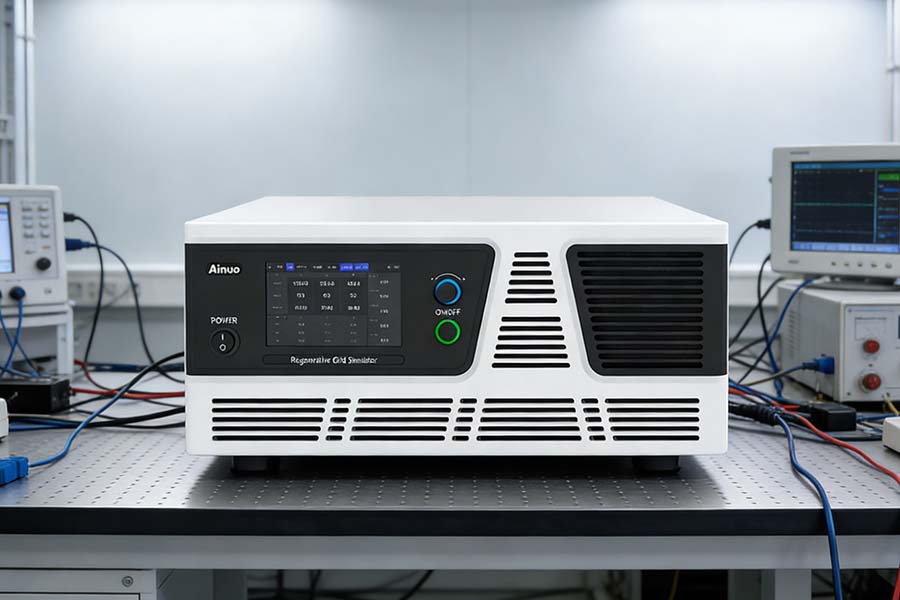
The ANRGL(F) Regenerative Grid Load — A Closer Look
The ANRGL(F) series is a sophisticated regenerative grid load and AC source designed for demanding applications such as:
- Photovoltaic inverters
- Energy storage systems (PCS)
- Switching power supplies
- Uninterruptible power supplies (UPS)
- Laboratory and third-party certification testing
Key Technical Highlights
Four-Quadrant Power Operation
The ANRGL(F) integrates sourcing and load capabilities in one unit, capable of both supplying power to the DUT and absorbing energy with high efficiency, providing feedback to the grid, and reducing test energy costs.
Wide Output Flexibility
It supports multiple modes, including:
- AC only
- DC only
- AC + DC combined outputs
This flexibility enables testing of a broad array of power electronics.
Programmable Waveforms and Grid Simulation
The unit can simulate grid abnormalities such as voltage sags, surges, harmonic distortion, and frequency variations — crucial for stress testing.
Digital Control and Communication
Sophisticated digital control via SPWM and FPGA technologies enables precise control, while communication interfaces (RS485, Ethernet, optional RS232/GPIB) support integration with automated test systems.
Why Regenerative Source-Load Testing Matters for EV OBCs
The OBC in EVs must endure a wide range of real-world grid conditions and power disturbances. Traditional testing using unidirectional power supplies and static loads is no longer sufficient for today's technical and regulatory demands.
Critical OBC Test Requirements
According to testing practitioners and suppliers like Keysight, Keysight's EV OBC test solutions often emphasize the need to:
- Emulate and sequence various grid voltage and frequency conditions
- Replicate power line disturbances (sags, surges, interruptions)
- Stimulate transient responses and stress conditions
- Measure AC/DC performance under dynamic load conditions
These requirements ensure interoperability across regions and charging infrastructure.
The Limits of Traditional Test Equipment
Conventional approaches — separate AC sources plus resistive/dynamic loads — create challenges:
- Low energy efficiency due to power dissipation as heat
- Inability to accurately emulate real-world, dynamic load states
- Difficulties in four-quadrant testing are needed for modern bidirectional flow
- Higher operating cost and need for multiple instruments to emulate complex conditions
These limitations can mask potential faults or limit the ability to perform full compliance testing.
EV OBC Test Challenges & How Regenerative Systems Address Them
Let's explore the current challenges faced in OBC testing and how regenerative AC source-load solutions like ANRGL(F) answer them.
Challenge 1: Recreating Real-World Grid Disturbances
Issue:
EV OBCs must tolerate realistic grid events such as voltage dips, swells, frequency shifts, and momentary interruptions — conditions that traditional linear sources struggle to replicate dynamically.
Solution:
Regenerative source-load systems provide programmable waveform generation and rapid output parameter modulation to simulate real grid disturbances for thorough stress testing. This capability enables certification of OBC immunity and robustness under adverse electrical environments.
Challenge 2: Bidirectional Power Flow Testing
Issue:
Future EV systems increasingly support bidirectional energy flow — for example, vehicle-to-grid (V2G) and vehicle-to-home (V2H) applications. OBCs and their associated converters must be tested for both power sourcing and power sinking performance.
Solution:
Four-quadrant regenerative systems allow seamless transition between sourcing and loading modes, enabling accurate dynamic testing of both directions without the need for separate source and load hardware.
Challenge 3: Efficiency and Energy Cost
Issue:
Running high-power OBC tests over long production cycles can lead to large energy consumption costs. Conventional electronic loads dissipate energy as heat, requiring expensive cooling infrastructure.
Solution:
Regenerative AC load technology, such as that implemented in ANRGL(F), returns absorbed power to the grid, dramatically improving energy efficiency and reducing operational costs — a critical advantage for high-volume EV testing labs.
Challenge 4: Compliance with International Standards
Issue:
OBCs must meet stringent safety and performance standards across multiple regions (IEC, ISO, automotive OEM specifications, grid codes). This includes harmonic emission limits, power factor requirements, and immunity to disturbances.
Solution:
Regenerative units provide advanced programmable testing sequences, harmonic injection, and precise waveform control, thereby supporting compliance verification across global standards.
Practical Application Example: OBC Test Flow
A typical EV OBC test setup leveraging regenerative AC source-load equipment involves:
- Grid Emulation: Programmable source replicates AC grid conditions expected in target markets.
- Dynamic Disturbances: Burst pulses, voltage sags, and frequency shifts are applied to gauge OBC response.
- Load Variation: Using programmable load modes (constant current, constant power, RLC) to simulate battery and grid interactions under different operating regimes.
- Data Acquisition: Voltage, current, power quality, harmonic performance, and thermal response are measured.
- Compliance Verification: Results are benchmarked against global standards to validate design integrity.
Why Ainuo ANRGL(F) Is Well-Suited for EV Test Labs
Compared to traditional test equipment, regenerative AC source-load systems like the ANRGL(F) bring several advantages:
- Energy Feedback: Returns up to 100% of test energy to the grid — reducing test electricity costs.
- Comprehensive Modes: Supports AC, DC, and hybrid AC+DC operations.
- Programmable Sequences: Enables complex sequences for disturbance and stress tests.
- Flexible Operation: Four-quadrant performance and parallel unit expansion for higher power levels.
- Integration Ready: Communication interfaces and software support make it suitable for automated test setups.
Conclusion
Testing EV onboard chargers is becoming exponentially more complex as EV power systems evolve. Today's EV test engineers must tackle not only power performance and efficiency, but also system resilience under adverse conditions, regulatory compliance, and future capabilities like bidirectional charging.
Regenerative AC source and load systems, like Ainuo's ANRGL(F), are designed precisely for this challenge — offering high-fidelity, energy-efficient, programmable testing capabilities that align with the current and future demands of EV OBC testing.
For labs, OEMs, and third-party test houses seeking robust OBC validation capabilities, regenerative solutions represent a pivotal shift from traditional source plus load stacks toward integrated, efficient, and scalable test platforms.
If you're building or upgrading your EV test suite, exploring regenerative AC source-load technology isn't just useful — it's fast becoming essential.



 TEL:+86 532 83995188
 PHONE:+86 177 5322 5039
 E-MAIL:ainuo@ainuo.com
 ADDRESS:No. 134 Zhuzhou Rd, Laoshan District, Qingdao, China