Programmable DC power supplies are vital tools in electronics design, testing, manufacturing, and research laboratories. Unlike basic fixed-output supplies, programmable models let engineers precisely set voltage, current, and sometimes power via software or digital interfaces. This precise control makes them essential for automated testing, product validation, and complex experimentation.
From powering delicate semiconductor devices to simulating battery behavior in electric vehicle testing, programmable power supplies provide the flexibility and precision needed in modern electronics development. However, choosing the right unit requires understanding the key specifications and features that determine performance, reliability, and usability.
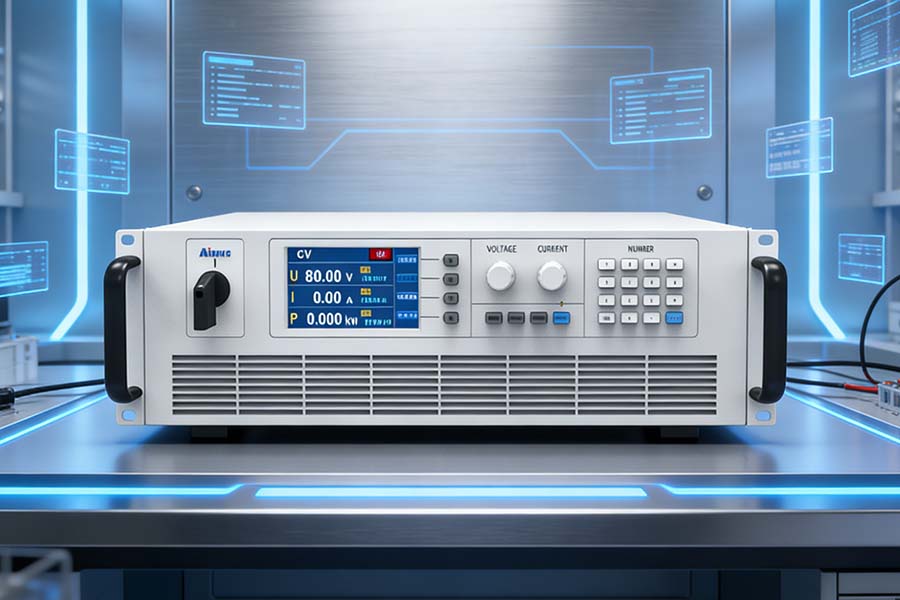
In this article, we will examine the key features to consider when selecting a programmable DC power supply, enabling engineers and researchers to choose the most suitable instrument for their specific application.
The most crucial specification when assessing a programmable DC power supply is its maximum output limits, which span voltage, current, and overall power.
These three parameters determine whether the power supply can deliver sufficient energy to the device under test (DUT). Engineers must ensure the supply can meet both the required voltage and current simultaneously, while also staying within the power rating of the instrument.
For example:
Voltage range: 0–32 V
Current range: 0–3.2 A
Maximum power: 220 W
Such ranges allow the power supply to support a wide variety of electronic testing scenarios, from small sensor circuits to high-power devices.
When evaluating power ratings, it is also important to consider:
Dynamic load conditions
Peak current requirements
Future testing needs
Selecting a power supply with some margin beyond your current requirements ensures flexibility for future projects.
A programmable DC power supply typically operates in several regulation modes that determine how it maintains a stable output under different load conditions.
The most common modes include:
In CV mode, the power supply maintains a constant output voltage while allowing current to vary depending on the load resistance. This mode effectively turns the supply into a stable voltage source.
CV mode is widely used for:
Powering electronic circuits
Digital system testing
Analog component characterization
In CC mode, the supply regulates the current while the output voltage adjusts automatically to maintain that current level. This mode is commonly used in applications like LED testing, battery charging, and device stress testing.
If a load attempts to draw more current than the set limit, the power supply automatically switches from CV to CC mode to prevent damage.
CP mode maintains constant power output by dynamically adjusting voltage and current. This feature is particularly useful for:
Battery simulation
Solar panel testing
Power electronics evaluation
Many modern programmable supplies support all three modes to accommodate different testing scenarios.
Programmable DC power supplies are designed for integration into automated test systems. Therefore, remote programming and control interfaces are critical features.
Common control interfaces include:
USB
Ethernet (LAN)
RS-232
GPIB
SCPI command compatibility
These interfaces allow the power supply to be controlled by computers, enabling automated test scripts and system integration.
Remote control capabilities are essential for:
Automated production testing
Long-duration experiments
Remote monitoring and logging
Some advanced power supplies also support programmable waveform generation, step sequencing, and scripting functions that simulate real-world electrical conditions.
Precision is another critical consideration when choosing a programmable DC power supply. Accurate voltage and current control ensure that measurements and test results are reliable.
Key specifications include:
Resolution refers to the smallest increment in which voltage or current can be adjusted.
For example:
Voltage resolution: 1 mV
Current resolution: 1 mA
High resolution allows engineers to make fine adjustments during sensitive testing procedures.
Regulation describes how well the power supply maintains a stable output under changing conditions.
Two types of regulation are important:
Line regulation: stability despite changes in input voltage
Load regulation: stability despite changes in load current
Good regulation ensures stable power delivery even when the system conditions fluctuate.
Ripple and noise are unwanted fluctuations in the output voltage of a power supply. These variations occur because AC power must first be rectified and filtered to produce DC output.
In sensitive electronic applications, excessive ripple can cause:
Measurement errors
Signal distortion
System instability
Ripple and noise are often specified as:
RMS voltage ripple
Peak-to-peak noise voltage
For precision electronics, low ripple levels are essential. Some high-quality programmable supplies maintain ripple values in the microvolt range, ensuring extremely stable output.
Applications requiring low ripple include:
RF circuit testing
Analog signal processing
semiconductor characterization
Electronic devices often experience sudden changes in current demand. A power supply must respond quickly to these changes to maintain a stable voltage output.
This capability is described by the transient response, which indicates how quickly the power supply recovers when the load changes abruptly.
Key metrics include:
Rise time
Settling time
Recovery time
A fast transient response ensures that the output voltage returns to its programmed value quickly after load fluctuations.
This feature is especially important when testing:
Digital processors
communication devices
power electronics
Protection mechanisms are essential to prevent damage to both the power supply and the device under test.
Common protection features include:
Overvoltage Protection (OVP)
Overcurrent Protection (OCP)
Overpower Protection (OPP)
Overtemperature Protection (OTP)
These safeguards automatically shut down or limit output when abnormal conditions occur.
For example:
OVP prevents excessive voltage from damaging sensitive components.
OCP protects circuits from drawing excessive current.
OTP prevents overheating inside the power supply.
Robust protection features are particularly important in automated testing environments where equipment may run continuously for extended periods.
One often overlooked but highly valuable feature is remote sensing, also known as 4-wire sensing.
In many test setups, the voltage measured at the power supply output terminals is not exactly the same as the voltage reaching the device under test. This difference occurs due to resistance in the connecting cables.
Remote sensing compensates for this effect by measuring voltage directly at the load, ensuring that the programmed voltage is accurately delivered to the device.
Benefits of remote sensing include:
Improved voltage accuracy
Reduced measurement error
Better performance in high-current applications
Some programmable DC power supplies provide multiple independent output channels.
Multi-channel systems allow engineers to:
Power multiple circuits simultaneously
Test complex systems with different voltage rails
Perform synchronized testing
For instance, a triple-output supply may allow each channel to be independently controlled with separate voltage and current settings.
This feature is particularly useful in applications like:
microcontroller development boards
analog/digital mixed-signal systems
operational amplifier circuits
Ease of use is another important consideration.
Modern programmable power supplies often include:
Color LCD or touchscreen displays
Graphical waveform displays
Intuitive control menus
These interfaces allow users to quickly monitor output parameters such as:
voltage
current
power
system status
A clear and user-friendly interface reduces setup time and improves overall productivity in laboratory environments.
In addition to the core features discussed above, many modern programmable DC power supplies offer advanced capabilities such as:
Output sequencing
Waveform generation
Battery simulation
Data logging
Parallel or series operation
These features enable engineers to simulate complex power conditions and create automated testing workflows.
For example, waveform generation allows the power supply to simulate fluctuating power conditions similar to those experienced in real-world applications.
Programmable DC power supplies are powerful tools that play a critical role in modern electronics development, testing, and manufacturing. Selecting the right power supply requires careful consideration of several key features, including output capability, operating modes, accuracy, ripple performance, and remote control interfaces.
Engineers should evaluate their specific application requirements before choosing a power supply. Factors such as load conditions, automation needs, measurement precision, and future scalability all influence the ideal choice.
By focusing on the essential features outlined in this article—such as CV/CC/CP operating modes, low ripple output, fast transient response, and advanced protection mechanisms—engineers can ensure they select a programmable DC power supply that delivers reliable performance and supports their testing needs.
As electronic systems continue to grow more complex, programmable power supplies will remain indispensable instruments for ensuring safe, accurate, and efficient power delivery in research labs and production environments alike.
*Please fill in the required information carefully, and we will contact you within 4-8 hours.

 TEL:+86 532 83995188
 PHONE:+86 177 5322 5039
 E-MAIL:ainuo@ainuo.com
 ADDRESS:No. 134 Zhuzhou Rd, Laoshan District, Qingdao, China


Copyright©2025. Aino Instrument Co., Ltd All Rights Reserved.
Powered by:WDL