Industrial environments rely heavily on electrical power to operate machinery, automate processes, and maintain production efficiency. Among the different types of electrical power systems, three-phase AC supply has become the standard for industrial applications due to its efficiency, reliability, and ability to handle heavy loads. From manufacturing plants and processing facilities to large commercial complexes, three-phase power plays a critical role in driving motors, compressors, pumps, and other essential equipment.
This article explores how a three-phase AC supply works, why it is widely used for industrial machines, and the key benefits and challenges associated with implementing and maintaining such systems.
A three-phase AC supply is a method of generating, transmitting, and distributing electrical power using three alternating currents that are out of phase with each other by 120 degrees. These three electrical waves operate simultaneously, providing a continuous and balanced flow of power.
In a three-phase system, power is delivered through three conductors, often referred to as Phase A, Phase B, and Phase C. In many cases, a neutral wire may also be included, depending on the configuration.
The major configurations used in three-phase systems are:
These configurations determine how voltage and current are distributed to industrial equipment.
One of the most important advantages of three-phase systems is their ability to deliver constant power, unlike single-phase systems that experience fluctuations. This consistent power output makes three-phase electricity ideal for running heavy-duty industrial machinery.
Industrial machines typically require large amounts of electrical power to operate efficiently. Three-phase systems are capable of delivering higher power levels with improved stability compared to single-phase systems.
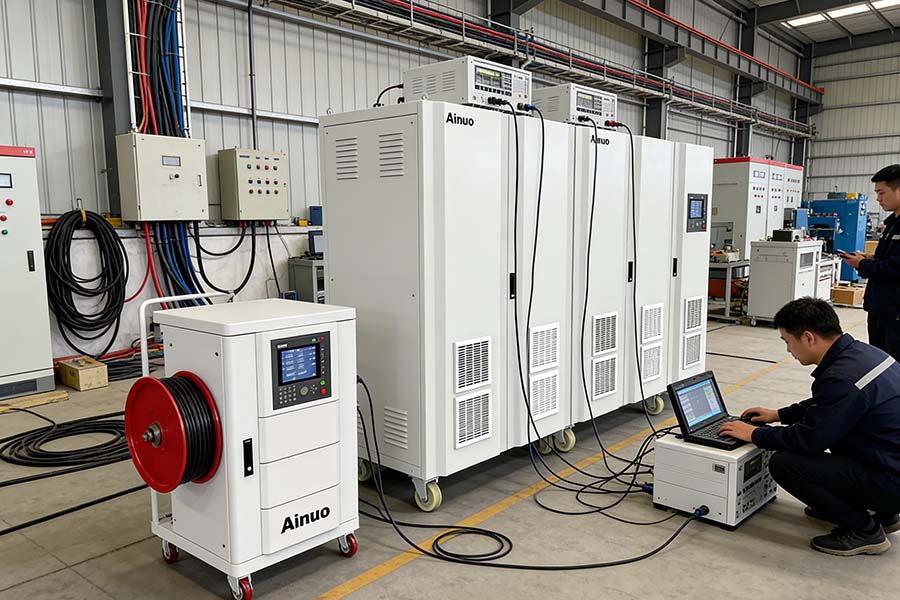
Most industrial equipment is designed to operate using three-phase power because it provides:
Electric motors, which are widely used in industries, perform significantly better when powered by a three-phase supply. The rotating magnetic field created by three-phase power allows motors to start more easily and run smoothly without additional starting components.
One of the primary advantages of three-phase power is its ability to transmit more power using less conductor material. Industrial machines such as conveyor systems, compressors, and heavy pumps often require large amounts of electricity.
Three-phase systems distribute the load across three conductors, enabling the transmission of greater power without excessive heating or energy loss.
This makes the three-phase supply particularly suitable for:
With higher power capacity, industries can operate multiple machines simultaneously without overloading the system.
In single-phase systems, power output fluctuates because the voltage rises and falls during each cycle. This fluctuation can lead to vibration, inefficiency, and unstable machine operation.
Three-phase power eliminates this problem because the three waves are evenly spaced. When one phase reaches its peak, the other two phases are still supplying energy.
This creates a continuous flow of power, which is crucial for industrial machines that require stable operation.
Smooth power delivery results in:
These advantages help extend the lifespan of industrial equipment.
Electric motors are the backbone of industrial operations. Three-phase motors are widely used because they are simpler, more efficient, and more reliable than single-phase motors.
Three-phase motors offer several benefits:
The rotating magnetic field produced by a three-phase supply allows motors to operate smoothly without the need for complex starting mechanisms.
As a result, industries can reduce maintenance costs while achieving better machine performance.
Energy efficiency is a critical factor in industrial operations. Three-phase systems reduce power losses during transmission and distribution.
Since the power load is distributed across three phases, the current flowing through each conductor is lower compared to a single-phase system delivering the same power.
Lower current means:
This efficiency can significantly reduce electricity costs for large-scale industrial facilities.
Although the initial installation cost of three-phase systems may be higher, they are more economical in the long run for industrial applications.
Three-phase systems require:
For large factories and processing plants, these savings can be substantial over time.
Industrial facilities often operate multiple machines simultaneously. Three-phase systems allow electrical loads to be distributed evenly across the phases.
Balanced loads provide several advantages:
When loads are balanced properly, the system operates more efficiently and reliably.
While three-phase AC systems offer many advantages, they also present several challenges that industries must address.
Installing a three-phase electrical system can be more expensive than a single-phase system, especially for smaller facilities.
The infrastructure required includes:
These components increase the upfront cost of installation.
However, for facilities with high power demand, the long-term benefits usually outweigh the initial investment.
Three-phase systems are more complex than single-phase systems. Proper system design is necessary to ensure safe and efficient operation.
Engineers must consider several factors, including:
Incorrect system design can lead to problems such as voltage imbalance or equipment damage.
Therefore, professional electrical engineers are usually required to design and implement three-phase power systems.
One of the major challenges in three-phase systems is phase imbalance, which occurs when the load on each phase is not equal.
Phase imbalance can cause several problems, including:
To avoid these issues, industrial facilities must carefully distribute loads across all three phases.
Monitoring systems are often used to detect and correct imbalances before they cause serious damage.
Although three-phase systems are generally reliable, they still require regular maintenance to ensure optimal performance.
Maintenance tasks may include:
Without proper maintenance, electrical faults can occur, potentially leading to equipment damage or safety hazards.
Industrial electrical systems operate at high voltages and currents, which can pose serious safety risks.
Three-phase power systems can cause:
Strict safety protocols must be followed when working with industrial power systems.
These safety measures often include:
Ensuring worker safety is a top priority in any industrial environment.
Three-phase AC supply powers a wide range of industrial machines and systems.
Some common applications include:
Most industrial motors operate on three-phase power. These motors drive machinery such as:
Industrial production lines depend on three-phase power to operate machines like:
Large heating and cooling systems also rely on three-phase power to operate compressors and pumps efficiently.
Industries such as construction, mining, and metal processing use three-phase power to run heavy-duty equipment.
With the growth of automation and smart manufacturing, the demand for reliable electrical power continues to increase.
Technologies such as:
All require stable and efficient power supplies.
Three-phase AC systems provide the power infrastructure needed to support these advanced technologies.
In addition, renewable energy sources such as wind and solar farms often generate three-phase power for integration into electrical grids.
The future of industrial power systems is evolving rapidly with the integration of advanced technologies.
Several trends are shaping the future of three-phase power systems:
Modern industrial facilities use digital monitoring systems to track power consumption, detect faults, and improve energy efficiency.
VFDs allow industries to control the speed of three-phase motors, reducing energy consumption and improving machine performance.
Many industries are incorporating renewable energy sources into their power systems, requiring efficient three-phase distribution networks.
Governments and industries worldwide are focusing on improving energy efficiency and reducing carbon emissions, making efficient power systems more important than ever.
Three-phase AC supply is the foundation of modern industrial power systems. Its ability to deliver high power efficiently, provide continuous energy flow, and support large-scale machinery makes it indispensable for industrial operations.
The benefits of three-phase power include improved motor performance, higher efficiency, reduced energy losses, and reliable power delivery. These advantages allow industries to operate complex machinery and large production systems effectively.
However, implementing and maintaining three-phase systems also presents challenges. Higher installation costs, system complexity, phase imbalance, and safety concerns require careful planning and management.
Despite these challenges, the advantages of a three-phase AC supply far outweigh the drawbacks for most industrial applications. As industries continue to adopt automation, smart technologies, and energy-efficient practices, three-phase power will remain a critical component of the global industrial infrastructure.
Understanding both the benefits and challenges of three-phase AC systems enables engineers, technicians, and facility managers to design more efficient and reliable industrial power systems for the future.
*Please fill in the required information carefully, and we will contact you within 4-8 hours.

 TEL:+86 532 83995188
 PHONE:+86 177 5322 5039
 E-MAIL:ainuo@ainuo.com
 ADDRESS:No. 134 Zhuzhou Rd, Laoshan District, Qingdao, China


Copyright©2025. Aino Instrument Co., Ltd All Rights Reserved.
Powered by:WDL