The global transition toward new energy vehicles (NEVs), particularly electric vehicles (EVs), has placed unprecedented emphasis on efficiency, performance, and reliability. As automakers compete to deliver longer driving ranges, faster charging, and better overall performance, accurate power measurement has become a cornerstone of innovation.
At the center of this effort lies a critical piece of test equipment: the high precision power analyzer. While it may not receive the same attention as batteries or motors, this instrument plays a decisive role in determining how efficiently an EV operates.
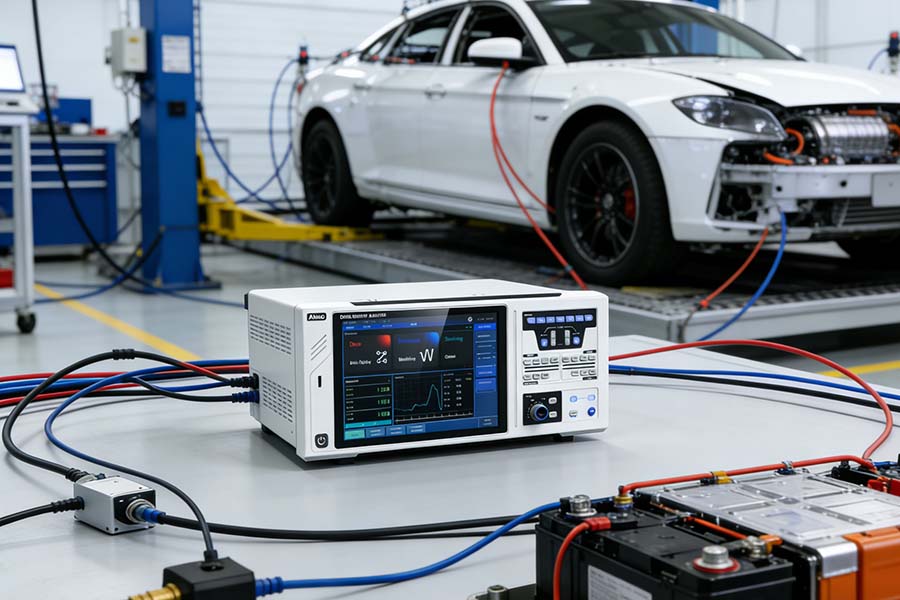
In this article, we’ll explore why high precision power analyzers are essential for accurate EV efficiency testing, how they work, and the impact they have across the entire EV development lifecycle.
The Importance of Efficiency in Electric Vehicles
Efficiency is one of the most important performance indicators for EVs. Unlike internal combustion engine vehicles, where fuel consumption is relatively forgiving, EVs rely entirely on stored electrical energy. Every watt lost translates directly into reduced driving range.
Key efficiency considerations include:
- Battery-to-wheel energy conversion
- Powertrain losses
- Charging and discharging efficiency
- Thermal losses
- Auxiliary system consumption
Even small inefficiencies—on the order of 1–2%—can significantly affect vehicle range and energy consumption ratings. This is why precise measurement is not optional—it is essential.
What Is a High Precision Power Analyzer?
A high precision power analyzer is an advanced measurement instrument designed to accurately capture electrical parameters such as:
- Voltage
- Current
- Power (active, reactive, and apparent)
- Energy consumption
- Power factor
- Harmonics
What sets high precision analyzers apart is their exceptional accuracy, often reaching levels as low as ±0.01% or better, along with high sampling rates and wide bandwidth capabilities.
These features enable engineers to measure complex, fast-changing electrical signals typical in EV systems.
Why Standard Measurement Tools Fall Short
Traditional instruments like multimeters, oscilloscopes, or basic power meters are not designed to handle the complexity of EV systems.
Limitations of Conventional Tools:
- Lower accuracy → leads to measurement errors
- Limited bandwidth → cannot capture high-frequency switching signals
- Inadequate synchronization → poor correlation between voltage and current
- Minimal harmonic analysis → misses distortion effects
In EV applications, where inverters operate at high switching frequencies and loads change rapidly, these limitations can result in misleading data.
High precision power analyzers overcome these challenges, providing reliable insights that engineers can trust.
The Complexity of EV Power Systems
To understand the importance of precision, it’s essential to examine the complexity of EV electrical systems.
Key Components Include:
- Battery packs (high voltage DC sources)
- Inverters (DC to AC conversion for motors)
- Electric motors
- DC-DC converters
- Onboard chargers (OBCs)
Each component introduces unique electrical characteristics, including:
- Rapid switching transients
- Non-linear loads
- Harmonic distortions
- Bidirectional energy flow
Accurately measuring these phenomena requires advanced instrumentation with high resolution and synchronization capabilities.
The Role of High Precision Power Analyzers in EV Efficiency Testing
High precision power analyzers are used throughout EV development to evaluate efficiency at multiple levels.
1. Battery Efficiency Measurement
Battery performance directly determines vehicle range and reliability.
Power analyzers help measure:
- Charge/discharge efficiency
- Energy losses during cycling
- Voltage and current stability
Accurate data enables engineers to optimize battery chemistry, design, and management systems.
2. Inverter and Motor Efficiency
The inverter converts DC power from the battery into AC power for the motor, making it a critical component in the powertrain.
Power analyzers allow engineers to:
- Measure input vs. output power
- Analyze switching losses
- Evaluate motor drive efficiency
Even small improvements in inverter efficiency can lead to significant gains in overall vehicle performance.
3. Powertrain System Optimization
Efficiency must be evaluated not only at the component level but also at the system level.
High precision power analyzers enable:
- End-to-end energy flow analysis
- Identification of loss points
- Optimization of control strategies
This holistic approach ensures maximum efficiency across the entire powertrain.
4. Charging System Testing
Charging efficiency is another critical factor for EV users.
Power analyzers are used to:
- Measure AC-to-DC conversion efficiency
- Evaluate power factor and harmonics
- Ensure compliance with grid standards
Accurate testing ensures faster, safer, and more efficient charging.
The Impact of Measurement Accuracy
Measurement accuracy directly influences engineering decisions.
Consider This Example:
If a power analyzer has an error margin of ±1%, an efficiency measurement of 95% could actually range between 94% and 96%.
In contrast, a high precision analyzer with ±0.05% accuracy reduces uncertainty dramatically, enabling engineers to:
- Detect small efficiency improvements
- Validate design changes
- Make data-driven decisions
In competitive EV markets, these small differences can determine success or failure.
High-Frequency Measurement Challenges
Modern EV systems operate at increasingly high switching frequencies, often in the tens or hundreds of kilohertz.
This introduces several challenges:
1. Signal Distortion
High-frequency switching generates harmonics that distort waveforms.
2. Measurement Noise
Electromagnetic interference (EMI) can affect signal integrity.
3. Phase Shift Errors
Even slight timing mismatches between voltage and current measurements can lead to significant power calculation errors.
High precision power analyzers address these challenges through:
- Wide bandwidth sensors
- High-speed sampling
- Advanced filtering techniques
- Precise time synchronization
Harmonic Analysis and Power Quality
Harmonics play a significant role in EV efficiency and system reliability.
Poor power quality can lead to:
- Increased losses
- Component overheating
- Reduced system lifespan
High precision power analyzers provide detailed harmonic analysis, enabling engineers to:
- Identify distortion sources
- Improve inverter design
- Ensure compliance with standards
Supporting Regulatory Compliance
EV manufacturers must comply with various global efficiency and emissions standards.
Examples include:
- WLTP (Worldwide Harmonized Light Vehicles Test Procedure)
- EPA efficiency standards
- IEC and ISO testing requirements
Accurate power measurement is essential for:
- Certification testing
- Reporting energy consumption
- Meeting regulatory benchmarks
High precision power analyzers ensure that test results are reliable and defensible.
Integration with Advanced Testing Systems
Modern EV testing environments are highly integrated.
High precision power analyzers can be connected with:
- Electronic load testers
- Battery cyclers
- Thermal chambers
- Hardware-in-the-loop (HIL) systems
This integration enables:
- Automated testing workflows
- Real-time data analysis
- Comprehensive system validation
Benefits of Using High Precision Power Analyzers
1. Enhanced Accuracy
Provides highly reliable data for critical engineering decisions.
2. Improved Efficiency Optimization
Enables detection of even minor performance improvements.
3. Faster Development Cycles
Reduces time spent on debugging and retesting.
4. Better Product Quality
Ensures that EV systems meet performance and reliability targets.
5. Competitive Advantage
Helps manufacturers deliver more efficient and higher-performing vehicles.
Real-World Application: EV Powertrain Development
Let’s consider how a high precision power analyzer is used in a real-world scenario.
Step 1: Prototype Testing
Engineers measure the baseline efficiency of the powertrain.
Step 2: Component Optimization
Data reveals inefficiencies in the inverter, leading to design improvements.
Step 3: System Integration
The analyzer measures overall system performance under simulated driving conditions.
Step 4: Validation
Final testing ensures compliance with efficiency standards.
Without high precision measurement, these steps would rely on assumptions rather than accurate data.
Future Trends in Power Measurement for EVs
As EV technology evolves, so do the requirements for power measurement.
Emerging Trends Include:
- Higher voltage systems (800V and beyond)
- Wide bandgap semiconductors (SiC, GaN)
- Increased switching frequencies
- AI-driven data analysis
- Cloud-based testing platforms
These advancements demand even greater measurement accuracy and capability, further reinforcing the importance of high precision power analyzers.
Conclusion
High precision power analyzers are not just measurement tools—they are enablers of innovation in the EV industry. By providing accurate, reliable, and detailed insights into electrical performance, they empower engineers to optimize efficiency, improve system design, and ensure regulatory compliance.
In a world where every watt matters, the ability to measure power with extreme precision is a decisive advantage. From battery testing to powertrain optimization and charging system validation, high precision power analyzers are essential for bringing efficient, reliable, and high-performing electric vehicles from concept to reality.
As the demand for NEVs continues to grow, so too will the need for advanced testing solutions. And at the heart of these solutions will remain one indispensable tool: the high precision power analyzer.



 TEL:+86 532 83995188
 PHONE:+86 177 5322 5039
 E-MAIL:ainuo@ainuo.com
 ADDRESS:No. 134 Zhuzhou Rd, Laoshan District, Qingdao, China