Introduction
Selecting the right bidirectional DC power supply is essential for efficient and reliable EV onboard charger (OBC) testing. Engineers must consider key specifications such as voltage range, power capacity, source and sink functions, regenerative feedback efficiency, dynamic response, and programmable capabilities. This article explores the key factors engineers should evaluate before purchasing a bidirectional DC power supply and introduces Ainuo's ANEVH(F) Programmable Bidirectional DC Power Supply as a solution for automotive power electronics testing.
1. Understand Your OBC Testing Requirements First
Before comparing equipment specifications, engineers should clearly define their testing objectives.
Different OBC designs and testing stages require different electrical capabilities.
For example, conventional OBC testing may focus on AC-to-DC conversion performance, battery-side voltage simulation, and output regulation. Bidirectional OBC testing may additionally require reverse power flow and switching between charging and discharging modes.
Typical OBC testing requirements include:
DC voltage and current performance testing.
Charging power and output regulation testing.
Battery-side voltage simulation.
Dynamic response testing.
Conversion efficiency measurement.
Protection function verification.
Long-duration reliability testing.
Reverse power flow testing for bidirectional OBCs.
Purchasing tip: Prepare a test requirement document before contacting suppliers. Include the maximum DC voltage, current, power, operating modes, transient requirements, and expected future expansion.
This helps engineers identify suitable equipment rather than purchasing a power supply based only on its maximum power rating.
2. Check the DC Voltage and Current Range
Voltage and current range are among the most important specifications when selecting a bidirectional DC power supply.
The equipment must cover the operating voltage and current requirements of the OBC's DC-side test interface.
Why Is Voltage Range Important?
Different EV battery platforms operate at different voltage levels. As high-voltage battery architectures continue to develop, testing laboratories may need equipment capable of supporting a wider voltage range.
An insufficient voltage range can limit the types of OBCs that a laboratory can test.
When selecting equipment, consider:
Minimum programmable output voltage.
Maximum DC voltage.
Voltage regulation accuracy.
Voltage resolution.
Maximum source and sink current.
Voltage and current limits in both operating directions.
Consider Future Voltage Requirements
If your laboratory expects to test different generations of EV power electronics, choosing a power supply with a wider voltage range can improve equipment utilization and reduce future replacement costs.
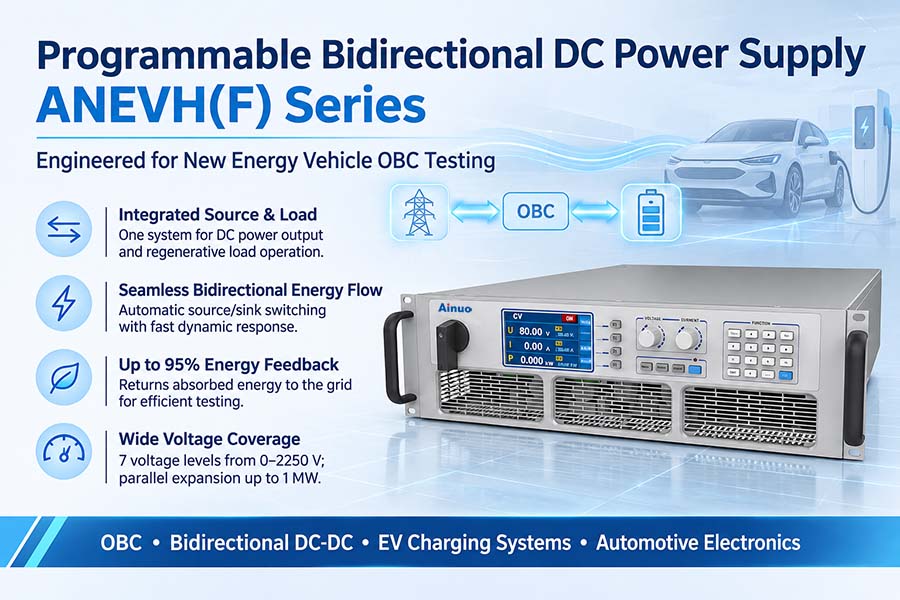
For example, Ainuo's ANEVH(F) series provides seven voltage levels covering 0 V to 2250 V, offering flexibility for different automotive electronics and high-voltage testing applications.
ainuoworld.com+1
3. Evaluate the Power Rating and Expansion Capability
The rated power of a bidirectional DC power supply determines how much electrical power it can deliver or absorb.
Engineers should select equipment based on the maximum continuous power requirements of the DUT, not just its typical operating power.
What Should Engineers Consider?
Rated power: Ensure the instrument can support the required continuous testing power.
Peak power: Check whether the equipment can handle short-duration power peaks and transient operating conditions.
Source and sink power: Confirm whether the rated power is available in both operating directions.
Parallel operation: Determine whether multiple units can operate together to increase total system power.
Future scalability: Consider whether the equipment can support higher-power testing as product requirements evolve.
Why Does Parallel Operation Matter?
As EV charging technologies advance, OBC and related power electronics testing may require higher power levels.
A modular or parallel-capable power supply allows laboratories to expand their test capacity without replacing the entire system.
Ainuo's ANEVH(F) series supports multiple units operating in parallel, with system power expandable up to 1 MW.
ainuoworld.com+1
4. Look for True Bidirectional Source and Sink Operation
One of the main reasons to purchase a bidirectional DC power supply is its ability to operate as both a power source and an electronic load.
However, engineers should carefully examine how the instrument performs these functions.
Source Mode
In source mode, the instrument supplies programmable DC voltage and current to the DUT.
This function can be used to simulate battery-side electrical conditions and evaluate the performance of automotive power conversion equipment.
Sink Mode
In sink mode, the instrument absorbs electrical energy from the DUT.
For equipment with regenerative feedback, absorbed energy is converted into AC power and returned to the grid.
Automatic Switching Between Source and Sink
For test sequences involving changes in power direction, seamless switching can simplify test procedures and improve system integration.
Before purchasing, check:
Whether source and sink functions are integrated into one instrument.
Whether the instrument supports automatic switching.
Whether switching introduces excessive voltage or current disturbances.
Whether the full rated power is available in both directions.
Whether the instrument supports the required operating quadrants.
For OBC testing, remember that reverse power flow is only applicable to OBCs designed for bidirectional operation. A bidirectional DC power supply does not make a conventional unidirectional OBC capable of reverse charging.
5. Consider Regenerative Energy Feedback Efficiency
Energy regeneration is another important factor when selecting a bidirectional DC power supply.
During OBC testing, electrical energy absorbed by the test equipment may otherwise be dissipated as heat. Conventional electronic loads generally use this approach, resulting in additional electricity consumption and heat generation.
A regenerative bidirectional DC power supply can convert absorbed DC energy into AC energy and feed it back into the electrical grid.
Why Does Feedback Efficiency Matter?
The feedback efficiency indicates how much of the absorbed energy can be returned to the grid. This demonstrates the potential energy-saving benefits of regenerative testing.
However, actual electricity savings depend on the operating conditions, system losses, auxiliary consumption, and the amount of energy absorbed during testing.
What Should Engineers Check?
Regenerative feedback efficiency.
Whether energy is returned directly to the AC grid.
Whether feedback operates throughout the required power range.
Grid connection requirements.
Power quality and harmonic performance.
Thermal management requirements.
Ainuo's ANEVH(F) series features regenerative energy feedback with a published maximum feedback efficiency of up to 95%. Engineers should confirm the applicable efficiency for their selected model and operating conditions.
Ainuo+1
6. Evaluate Dynamic Response and Switching Speed
Dynamic response is particularly important when testing OBCs and other automotive power conversion equipment.
During actual vehicle operation, voltage, current, and power demand may change rapidly. The OBC must respond appropriately to these changes while maintaining stable operation.
A bidirectional DC power supply with insufficient dynamic performance may introduce unwanted disturbances into the test system or limit the accuracy of certain transient tests.
Key Dynamic Performance Parameters
1. Transient response time
Measures how quickly the power supply responds to changes in the programmed operating conditions.
2. Source/sink switching time
Indicates how quickly the instrument changes between power delivery and energy absorption.
3. Voltage overshoot and undershoot
Shows the magnitude of voltage deviation during transient events.
4. Current response
Indicates how accurately and quickly the instrument follows programmed current changes.
5. Programming accuracy
Determines how closely the actual output follows the programmed voltage and current values.
Why Is This Important for OBC Testing?
Fast dynamic response can help engineers:
Evaluate OBC response to changing battery-side conditions.
Simulate transient electrical conditions.
Test power conversion stability.
Evaluate bidirectional power switching.
Improve automated test repeatability.
The Ainuo ANEVH(F) series specifies transient response and forward/reverse switching speeds of up to 2 ms under specified conditions.
Intepro Systems+1
7. Check Programmable Waveform Generation and Battery Simulation Functions
Modern OBC testing requires more than simply providing a fixed DC voltage.
Engineers often need to simulate changing electrical conditions to evaluate the behavior of the DUT under different operating scenarios.
A programmable bidirectional DC power supply with waveform generation and battery simulation capabilities can provide greater flexibility.
Programmable Waveform Generation
Waveform generation allows engineers to create different voltage or current profiles according to specific test requirements.
Useful capabilities include:
Arbitrary waveform generation.
Programmable voltage sequences.
Programmable current sequences.
Transient condition simulation.
Standard automotive electrical test curves.
For example, the ANEVH(F) series provides a built-in function generator and supports arbitrary waveform generation. It also offers optional automotive voltage test curves associated with DIN 40839, ISO 16750-2, and ISO 21848.
Ainuo+1
Battery Simulation
Battery simulation can help engineers reproduce selected battery-side electrical characteristics without using an actual high-voltage battery for every test.
Before purchasing, verify whether the instrument supports the battery simulation functions required by your test procedure, including:
Programmable battery voltage characteristics.
Battery output characteristic simulation.
Voltage response to changing current.
Required dynamic battery profiles.
Not every programmable DC power supply offers the same level of battery simulation. Engineers should distinguish between basic voltage/current programming and a dedicated battery model with dynamic characteristics.
8. Examine Measurement Accuracy, Protection, and Communication Interfaces
A bidirectional DC power supply must do more than deliver and absorb electrical energy. It must also provide reliable measurement, protection, and system integration.
8.1 Measurement Accuracy
Accurate voltage and current measurement is essential for evaluating OBC performance.
Engineers should check:
Voltage programming accuracy.
Current programming accuracy.
Voltage and current read-back accuracy.
Measurement resolution.
Measurement response and sampling rate.
For conversion efficiency testing, use an appropriate precision power analyzer to measure AC input power and DC output power. Do not rely solely on the DC power supply's read-back values for the complete efficiency calculation.
8.2 Protection Functions
High-voltage OBC testing requires comprehensive protection mechanisms.
Important protection functions include:
Overvoltage protection (OVP).
Overcurrent protection (OCP).
Overpower protection (OPP).
Overtemperature protection (OTP).
Emergency shutdown and external interlock compatibility.
Engineers should also verify insulation, grounding, discharge procedures, and protection coordination for the complete test system.
8.3 Communication Interfaces
Communication interfaces are important for integrating the power supply into automated test benches. Common interfaces include CAN, RS232, RS485, LAN, USB, GPIB (where available).
Ainuo's ANEVH(F) series provides RS232, RS485, CAN, LAN, and USB communication interfaces, supporting integration into automated testing environments.
A regenerative power supply may have a higher initial purchase price than a conventional power supply or dissipative electronic load. However, for laboratories conducting frequent, high-power testing, energy recovery can help reduce long-term operating expenses.
The best purchasing decision should consider both technical performance and the expected operating cost over the equipment's service life.
Why Consider Ainuo ANEVH(F) for OBC Testing?
For engineers looking for an integrated DC source and regenerative load solution, Ainuo's ANEVH(F) Programmable Bidirectional DC Power Supply is designed for automotive electronics, OBC testing, new energy vehicle power electronics, and high-power laboratory applications.
Its main features include:
Operating modes: Bidirectional source and sink
Voltage coverage: 0–2250 V across seven voltage levels
Power expansion: Parallel operation up to 1 MW
Feedback efficiency: Up to 95% published maximum
Dynamic response: Up to 2 ms under specified conditions
Switching speed: Up to 2 ms under specified conditions
Waveform generation: Built-in function generator
Automotive test curves: DIN 40839, ISO 16750-2, ISO 21848 (optional)
Communication: RS232, RS485, CAN, LAN, USB
How Can ANEVH(F) Support OBC Testing?
Integrated source and sink functions: Simplifies DC-side test system configuration by combining power supply and feedback load functions.
Wide voltage coverage: Supports a range of high-voltage automotive electronics testing requirements.
Regenerative energy feedback: Helps reduce energy waste during power absorption tests.
Fast dynamic response: Supports testing under changing electrical conditions.
Programmable waveforms: Provides flexibility when configuring automotive electrical test profiles.
Parallel expansion: Allows testing laboratories to increase system power as testing requirements grow.
The ANEVH(F) series is therefore worth evaluating for laboratories seeking a flexible DC-side test platform for OBC and other automotive power electronics applications.
Purchasing Checklist: Questions Engineers Should Ask Suppliers
Before placing an order, engineers should get clear answers to these questions.
Does the voltage range cover the maximum and minimum DC operating requirements?
Can the instrument deliver and absorb the required rated power?
Are source and sink power ratings identical?
Does it support automatic source/sink switching?
What is the regenerative feedback efficiency under actual operating conditions?
What are the transient response and switching times?
Does it support the required battery simulation functions?
Can it generate arbitrary waveforms and programmable sequences?
Are voltage and current measurement accuracies sufficient?
Does it provide comprehensive protection functions?
Are its communication interfaces compatible with the existing test system?
Can multiple units operate in parallel?
Does the supplier provide technical support, documentation, and after-sales service?
These questions help engineers compare products based on actual testing requirements rather than marketing specifications alone.
Conclusion
Choosing a suitable bidirectional DC power supply requires evaluating both technical performance and long-term operating costs. Key considerations include voltage and power range, bidirectional operation, energy feedback efficiency, dynamic response, programming functions, protection, and system scalability. With voltage coverage up to 2250 V, parallel power expansion up to 1 MW, and regenerative energy feedback, Ainuo's ANEVH(F) Programmable Bidirectional DC Power Supply offers a flexible solution for EV OBC and automotive power-electronics testing. Visit Ainuo's official website to explore the product or discuss your testing requirements with our technical team.
Looking for a suitable bidirectional DC power supply for your OBC testing application?
Visit Ainuo's official website to explore the ANEVH(F) series or contact our technical team to discuss your testing requirements.



 TEL:+86 532 83995188
 PHONE:+86 177 5322 5039
 E-MAIL:ainuo@ainuo.com
 ADDRESS:No. 134 Zhuzhou Rd, Laoshan District, Qingdao, China