In the rapidly evolving home appliance industry, electrical safety is no longer optional—it's a core requirement for compliance, consumer protection, and maintaining a strong brand reputation. Modern appliances are more powerful, interconnected, and technologically advanced than ever before. Whether it's a smart refrigerator, an induction cooktop, or a robotic vacuum, every appliance carries potential electrical risks if it's not properly tested.
To meet global safety standards and avoid costly failures, manufacturers rely on electrical safety testers. These devices verify that appliances are safe for daily household use and comply with regulations such as IEC, UL, CE, and CSA. In this SEO-optimized article, we'll explain why every home appliance manufacturer needs electrical safety testers and how they contribute to safer, more reliable products.
An electrical safety tester is a specialized device that checks whether an appliance meets required electrical safety standards. It detects hazards such as insulation failures, faulty wiring, excess leakage current, and insufficient grounding.
The most common tests performed include:
Applies high voltage to ensure insulation can withstand electrical stress.
Verifies the strength and continuity of the protective earth connection.
Measures the resistance of insulation to prevent current leakage.
Evaluates unintended currents that could pose shock hazards.
Confirms correct wiring and electrical connections.
These tests give manufacturers confidence that each appliance is safe, durable, and compliant with safety regulations.
Electrical malfunctions in the home are a leading cause of fires and accidents. Appliances operate near water, heat, and constant use—conditions that amplify risk.
Electrical safety testers identify issues like:
By detecting problems early, manufacturers eliminate dangers before appliances reach the customer.
To sell home appliances domestically or internationally, manufacturers must comply with standards such as:
IEC 60335 — Safety of Household and Similar Electrical Appliances
UL and CSA standards — North American compliance
CE Low Voltage Directive — European market
CB Scheme — International certification
Electrical safety testers are calibrated to align with these regulations, producing trustworthy and repeatable results. Without proof of compliance, manufacturers cannot legally sell their products in many regions.
Product recalls can cost millions and permanently damage a brand's reputation. Performing proper electrical testing greatly reduces:
Warranty costs
Returns and replacements
Field failures
Customer complaints
Regulatory penalties
A robust testing protocol ensures only safe, high-quality appliances reach consumers.
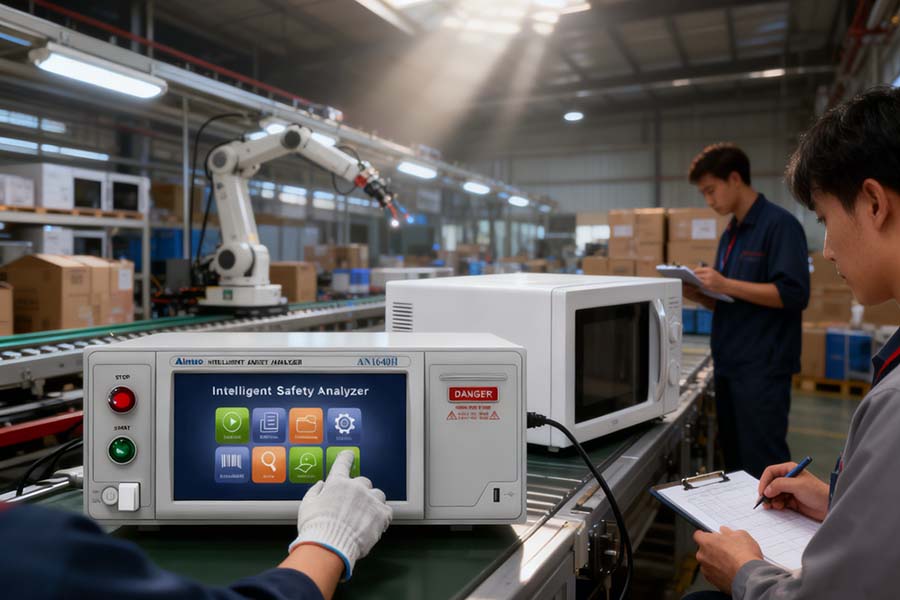
Modern electrical safety testers integrate directly into automated assembly lines. Automation delivers:
Faster testing cycles
Reduced labor costs
Lower risk of human error
Consistent safety standards
Real-time data logging and tracking
For high-volume appliance manufacturers, automated electrical safety testing is essential for maintaining speed and quality simultaneously.
When an appliance causes injury, fire, or property damage, the manufacturer may face:
Lawsuits
Government investigations
Mandatory recalls
Insurance claim rejections
Documented electrical safety testing is often required to defend against liability claims. A single untested appliance can expose a company to significant financial risk.
Ensures insulation can withstand voltage spikes, preventing shock hazards.
Confirms the protective earth circuit can safely redirect fault currents.
Identifies insulation breakdown before it becomes a safety risk.
Checks that the appliance does not allow dangerous current to escape.
Verifies that all conductive paths are properly connected.
Each test plays a distinct role in protecting users and meeting required safety certifications.
Well-tested appliances last longer due to better electrical integrity.
Fewer breakdowns and greater safety lead to stronger brand loyalty.
Advanced testers offer data export, audit trails, and automated QA workflows.
Retailers and distributors prefer brands with proven safety protocols.
When selecting electrical safety testing equipment, manufacturers should evaluate:
Types of tests required (hipot, leakage current, insulation resistance, etc.)
Production volume and automation needs
Regional and international compliance standards
Data storage, traceability, and reporting features
Integration with existing manufacturing systems
Expandable testing capabilities for future product lines
Investing in a versatile, high-performance tester ensures long-term value and safety consistency.
Manufacturers who skip or minimize electrical safety testing face major risks, including:
Increased chance of fires and electrocution incidents
Violations of safety regulations
Shipment rejections from distributors
Loss of insurance protection
Severe brand damage
Costly recalls and lawsuits
The financial and reputational consequences far outweigh the investment in safety testing equipment.
In an industry driven by innovation, consumer expectations, and stringent safety standards, electrical safety testers are indispensable tools. They ensure appliances are safe, compliant, and reliable before reaching homes around the world.
From preventing electrical hazards to reducing recalls and boosting brand trust, electrical safety testers play a critical role in modern appliance manufacturing. Simply put, no manufacturer can confidently launch products without a comprehensive electrical safety testing strategy.
Investing in the right electrical safety tester is not just about meeting regulations—it's about protecting your customers, your brand, and your business.
*Please fill in the required information carefully, and we will contact you within 4-8 hours.

 TEL:+86 532 83995188
 PHONE:+86 177 5322 5039
 E-MAIL:ainuo@ainuo.com
 ADDRESS:No. 134 Zhuzhou Rd, Laoshan District, Qingdao, China


Copyright©2025. Aino Instrument Co., Ltd All Rights Reserved.
Powered by:WDL