Whether you’re developing industrial drives, renewable energy inverters, smart grid components, or critical infrastructure systems, accurately simulating grid conditions is essential. At the heart of this capability lies the three-phase AC power supply — a versatile tool that can replicate the complexities of actual power systems.
A three-phase AC power supply is a type of electrical power distribution system where three alternating currents are generated, each phase shifted by 120°. Most large electrical loads — industrial motors, HVAC systems, data centers, and commercial buildings — rely on three-phase power because it delivers a more consistent and efficient energy flow than single-phase systems.
Unlike single-phase power, which pulses and can cause torque fluctuations in motors, three-phase power maintains a constant total power transfer throughout the cycle. This makes it ideal for heavy machinery and power-intensive applications.
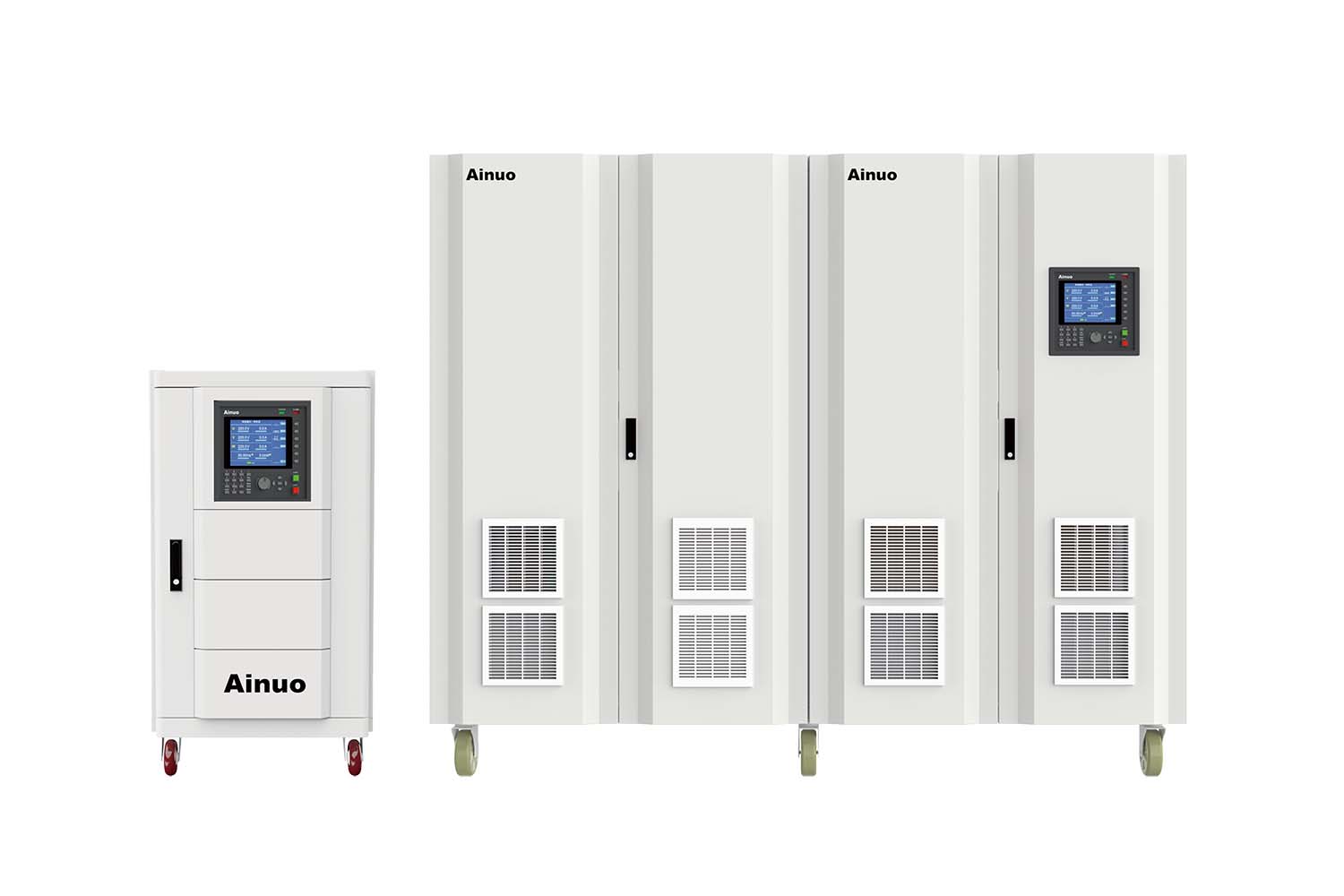
But in a simulation and testing context, a three-phase AC power supply becomes more than just a power source: it becomes a laboratory tool that can mimic the dynamic behavior of an actual power grid.
Before we dive into how three-phase supplies simulate grid conditions, it’s worth stepping back and asking why this matters in the first place.
Real-world power grids are not perfect sine waves. They suffer from:
Voltage sags, swells, and dips
Frequency variations
Phase imbalances
Harmonic distortion
Transients and spikes
Load changes over time
Electrical systems and devices deployed in the field must withstand these anomalies. Faults or deviations in supply can trigger failures, degrade performance, or even cause safety concerns. Laboratory testing under controlled and repeatable conditions helps engineers:
Validate design resilience
Improve product reliability
Ensure compliance with international standards (e.g., IEC, IEEE)
Reduce field failures and warranty costs
That's where advanced three-phase AC power supplies shine — they allow controlled emulation of grid behavior within safe, repeatable parameters.
Modern three-phase AC power supplies are much more than variable transformers. They are programmable instruments that can recreate complex grid phenomena. Key capabilities include:
Real grids can fluctuate. Three-phase supplies allow users to:
Set any nominal line voltage from low (e.g., 100 V) to high (e.g., 480 V) levels
Sweep frequency from below 50 Hz to above 60 Hz (and in some units, up to several kHz)
Apply slow drifts or rapid changes to mimic grid instability
This enables tests like:
Low-voltage ride-through (LVRT)
High-frequency events caused by generator switching
Frequency excursions during grid disturbances
By precisely controlling phase relationships, engineers can simulate:
Balanced vs. unbalanced loads
Phase shift events due to transformer connections
Fault conditions like single-phase dropouts
This is crucial for testing equipment that relies on phase sensing — such as motor drives, protective relays, or grid-tied inverters.
Real power systems contain harmonic components due to nonlinear loads (e.g., rectifiers, CPUs, LED drivers). Advanced three-phase supplies can superimpose harmonics onto the fundamental waveform.
Testing for harmonic immunity helps:
Validate filters and power factor correction units
Prevent overheating or misoperation in sensitive circuits
Ensure compliance with standards like IEEE 519
Transients are fast, short-lived disturbances caused by events such as lightning strikes, capacitor switching, or short circuits. Three-phase AC sources can inject:
Impulsive voltage spikes
Fast slew-rate changes
Controlled transient events for repeatable stress tests
This capability helps design robust surge protection and transient suppression techniques.
Let's explore how three-phase AC power supplies are used across various sectors.
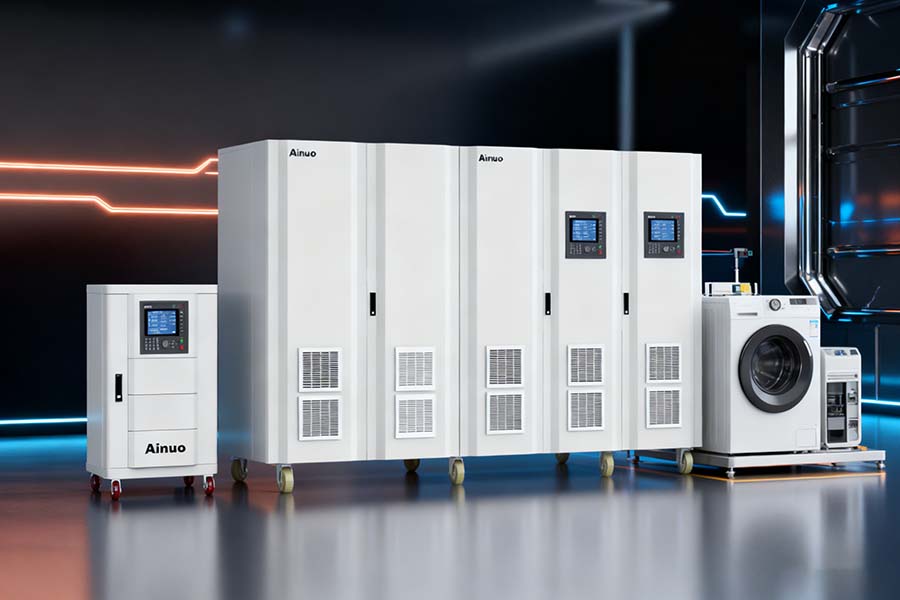
Three-phase motors and variable frequency drives (VFDs) are the workhorses of industrial plants. Before a drive is deployed, engineers need to verify:
Proper start/stop behavior under supply sags
Over/under voltage protection thresholds
Reaction to phase loss or imbalance
Using a programmable AC source, developers simulate grid disturbances and monitor drive response without disrupting actual production lines.
Renewables like solar and wind interface with the grid through inverters. Grid-tied inverters must comply with standards that require:
Synchronization with grid voltage and frequency
Ride-through capability during voltage dips
Low harmonic injection
By simulating these conditions in the lab, developers ensure that their systems behave correctly before utility integration.
Uninterruptible Power Supplies (UPS) protect mission-critical equipment. They must handle:
Short-term sags without switching to battery
Seamless transitions during outages
Load steps when servers ramp up
Engineers use three-phase AC supplies to stress-test UPS units for these scenarios safely.
EV charging infrastructure interacts with local grids and must handle:
Voltage variation due to nearby loads
Harmonics introduced by rectifiers
Interaction with renewable sources
Simulating these scenarios early in the design cycle enhances system stability and user experience.
Here's a practical methodology for using a three-phase AC source to simulate grid behavior:
Are you testing for voltage sag immunity? Harmonic tolerance? Frequency instability? Clarifying this determines the waveform parameters and instrumentation needed.
Outline the following:
Target voltage amplitude and range
Frequency sweep or variation
Phase conditions (balanced or unbalanced)
Duration of events
Safety cutoff limits
A clear plan ensures repeatability and consistency.
Modern sources let you upload profiles that define:
Custom waveforms with harmonics
Stress sequences (e.g., sag → swell → transient)
Looping patterns for endurance tests
This programmability enables complex scenario generation without manual intervention.
Voltage and current probes, power analyzers, and data loggers capture responses during the simulation. Ensure an adequate sampling rate to catch transients.
Review waveforms and system behavior. Key performance indicators might include:
Trip thresholds triggered
Voltage and current distortions
Thermal responses
Functional behavior under stress
Document findings and iterate as needed.
Accurate simulation requires careful consideration of both equipment and process. Here are some best practices:
Before introducing disturbances, record how the Device Under Test (DUT) behaves under nominal conditions. This provides a reference for comparison.
Ensure that measurement tools have appropriate bandwidth and resolution. Transients and harmonics can be missed with low-performance instruments.
High-power three-phase testing can be hazardous. Use appropriate personal protective equipment (PPE), isolation transformers, and safety protocols.
Periodically calibrate and verify your AC power supply against known standards or reference equipment to ensure that it produces accurate waveforms.
While it’s tempting to push systems to their limits, focus on conditions that could realistically occur in the target application. Overly exaggerated scenarios may not yield practical insights.
Even with advanced tools, simulation can be tricky. Here are common challenges and solutions:
Real grids can produce very fast, unpredictable transients. Reproducing these precisely may exceed the power supply’s capabilities.
Solution: Use a hybrid approach — combine programmable AC sources with specialized pulse generators or transient simulators designed for high dv/dt events.
High-resolution capture of voltage, current, and other parameters generates large data sets.
Solution: Use intelligent filtering and event-triggered logging to focus on critical periods rather than capturing all data continuously.
The behavior of the DUT may change depending on the load characteristics (resistive, inductive, capacitive).
Solution: Use programmable load banks to emulate realistic load dynamics, ensuring that simulations reflect true operating environments.
As electrical infrastructure becomes more complex — with increasing penetration of renewables, energy storage, and smart devices — the demand for realistic simulation grows. Emerging trends include:
Digital Twin Integration: Creating virtual models of equipment that run in parallel with hardware tests.
AI-Driven Test Profiles: Using machine learning to generate realistic disturbance patterns based on historical grid data.
Cloud-Connected Testing: Sharing test results and scenarios across distributed teams for collaborative development.
These advancements promise richer, more realistic testing and faster development cycles.
Simulating real-world grid conditions with three-phase AC power supplies is no longer a luxury — it’s a necessity. Whether you’re designing industrial machinery, renewable energy systems, protective relays, or critical power infrastructure, the ability to recreate realistic electrical environments in a controlled lab setting reduces risk, enhances reliability, and accelerates innovation.
From understanding voltage and frequency behavior to programming complex transient events, mastering grid simulation equips engineers with insights that translate directly into better products and safer systems. As power systems evolve, so too will the tools and methodologies we use to test them — but the foundational role of three-phase AC power supplies in realistic simulation is here to stay.
If you’re interested in exploring three-phase AC power supplies or setting up your own grid simulation lab, feel free to reach out — I’d be happy to help guide you through the process!
*Please fill in the required information carefully, and we will contact you within 4-8 hours.

 TEL:+86 532 83995188
 PHONE:+86 177 5322 5039
 E-MAIL:ainuo@ainuo.com
 ADDRESS:No. 134 Zhuzhou Rd, Laoshan District, Qingdao, China


Copyright©2025. Aino Instrument Co., Ltd All Rights Reserved.
Powered by:WDL